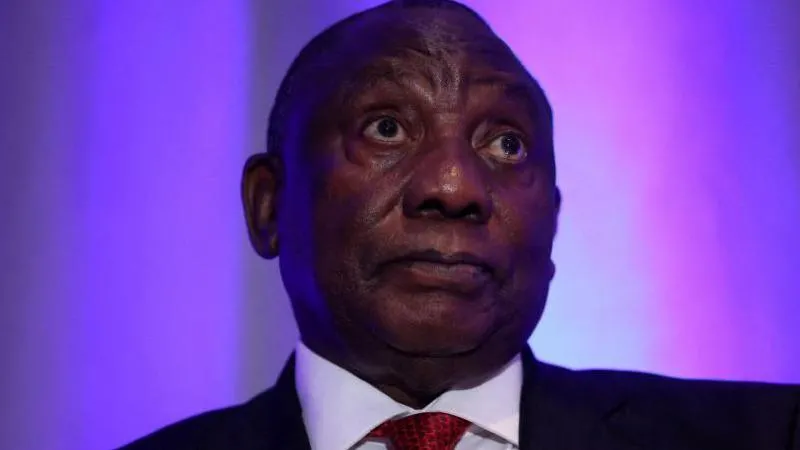
Cyril Ramaphosa, the president of South Africa, has resisted what he describes as “unilateral” higher trade tariffs that the United States has placed on his nation.
On Monday, US President Donald Trump declared that he would impose a new 30% duty on South African imports starting on August 1.
Trump’s tense relationship with Ramaphosa’s administration is evident in the fact that it is the only sub-Saharan African nation he specifically mentioned in his declaration.
Trump said that the US-South Africa trade relationship “has been, unfortunately, far from reciprocal” in a letter to Ramaphosa. Ramaphosa argued that the 30% tax “is not an accurate representation of available trade data” in his response.
South Africa has suffered greatly as a result of Trump’s decision. Under the African Growth and Opportunity Act (Agoa), South Africa’s automobile, agricultural, and textile industries were granted duty-free access to the US market, making the US its second-largest trading partner.
Trump’s announcement implied the end of Agoa, according to South Africa’s Agriculture Minister John Steenhuisen, even if he was not specific.
“More than ever, it highlights the need for urgent reform in South Africa so we can ensure our economy meets the requirements of our trading partners around the world,” Steenhuisen told lawmakers.
Trump informed 13 additional nations, including South Africa, in letters of his most recent tariff proposals.
Adjusting the tariffs “upward or downward, depending on our relationship with your country” is one option, according to the US president.
“We have had years to discuss our trading relationship with South Africa, and have concluded that we must move away from these long-term, and very persistent, trade deficits engendered by South Africa’s tariff, and non-tariff, policies and trade barriers,” Trump wrote in his letter.
“Starting on August 1, 2025, we will charge South Africa a tariff of only 30% on any and all South African products sent to the United States, separate from all sectoral tariffs,” he stated.
According to Trump, if South Africa decides to raise its duties in reaction to his statement, the additional amount will be added to the current 30%.
“If you wish to open your heretofore closed trading markets to the United States, and eliminate your tariff and non-tariff policies and trade barriers, we will, perhaps, consider an adjustment to this letter.”
Ramaphosa responded by contesting the increased duties, claiming that US and South African negotiation teams were still debating the matter.
“This 30% tariff is based on a particular interpretation of the balance of trade between South Africa and the United States,” Ramaphosa stated in a statement.
The average duty on the other items was 7.6%, he continued, and over half of the US imports into South Africa were tax-free.
In order to guarantee a “more balanced and mutually beneficial trade relationship” with the US, he stated that South Africa would keep up its diplomatic efforts.
As part of his global “reciprocal” tariffs, Trump levied a 30% duty on South Africa in April and then agreed to halt their application for ninety days.
Previously suspended, higher duties were scheduled to take effect on July 9; however, White House officials stated they would try to negotiate trade agreements.
A reporter questioned Trump if the revised August target was a hard deadline, and he responded, “I would say firm, but not 100% firm.” “We’re going to be open to doing something a different way if they call and say that.”
In an effort to stop Trump’s broad tariffs, South Africa and other nations on the continent have been pressuring the US to negotiate trade agreements.
Trump contends that imposing tariffs will increase domestic manufacturing and employment while shielding American companies from overseas competition.
Following Trump’s inauguration in January, ties between the US and South Africa reached a low point.
Due to allegations of discrimination against the white minority, the US president has halted all aid to South Africa. South Africa has rejected this on numerous occasions.
In an attempt to improve ties, Ramaphosa met with Trump in May.
Trump, however, challenged him on a number of contentious allegations regarding the murder of white farmers, and his most recent declaration implies that he is continuing to put pressure on South Africa.