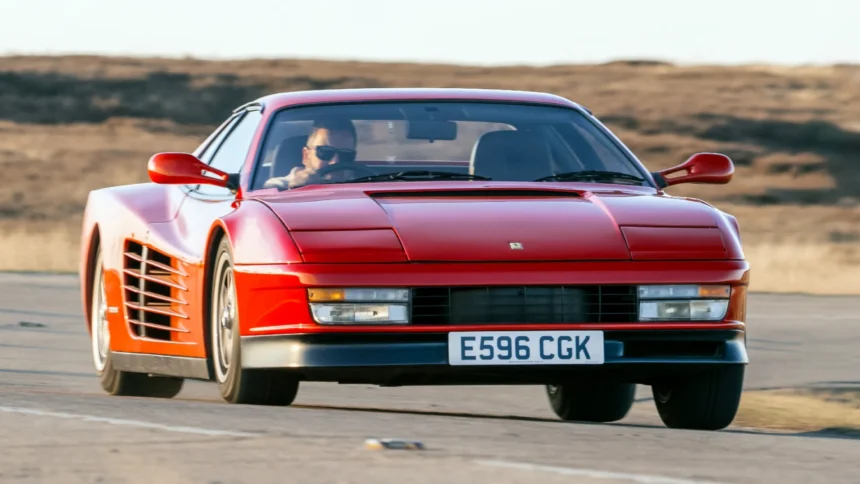
Nothing better captured the decadent more-is-more mentality of the 1980s than the Ferrari Testarossa, which was not featured in evo until issue 185 in 2013. The crimson cam covers of the Testarossa’s engine, a heavily modified version of the Berlinetta Boxer’s flat-12, gave rise to the nickname “redhead.”
What Ferrari referred to as “the world’s most powerful and most luxurious Gran Turismo car” made its debut at the 1984 Paris show and would be a part of the brand’s lineup for 12 years in a variety of configurations.
Before the brand-new 550 Maranello took over in 1996 to start a long-running dynasty of front-mid-engined V12 Ferrari grand tourers that continues today with the 12 Cilindri, the Testraossa was renamed 512 TR in 1991 and 512 TR became 512M in 1994.
Details and background
Engine 19 of the Ferrari Testarossa
However, the icon is the original Testarossa. The 4.9-liter flat-12 engine produced 385 horsepower at its peak, which was transferred to the back wheels using a five-speed gearbox. Since the cylinders have a 180-degree V rather than independent crankpins, it isn’t a boxer. Additionally, it was positioned very high on top of the differential and transmission. The chassis was made of tubular steel and had telescopic dampers, coil springs, and two wishbones of varying lengths. There was no help with the steering.
By today’s supercar standards, performance was lacking; it took 5.8 seconds to go from 0 to 62 mph and reached a top speed of 181 mph. The finned flanks became a hallmark of TR and a major element of its unique otherworldliness, yet they were a necessity since some markets would not permit the huge apertures required to feed the radiators that were moved rearwards. Performance Car, evo’s forerunner, adored it. “The Testarossa is as good as they come as a blend of outright speed and cruising comfort, roadholding and responsiveness, dynamics and driveability.”
Review of the Ferrari F80 2025: near-1200bhp tech showcase tested on the road and track
The Testarossa is wider than any modern Ferrari at 1976mm, and the black grille that spans the entire frontal width of the vehicle definitely highlights its enormous breadth. The single intake (serving an oil cooler) behind the headlight on the same side only highlights the unbalance, and the solitary mirror is really amazing but also occasionally looks really strange. Other angles don’t seem nearly as beautiful.
The nearly comically large front overhang is visible in profile, but it is still just as breathtakingly striking in motion, especially when cutting past the rocky rock and verdant grass of rural hillsides, as it was in the 1980s.
Interior of the Ferrari Testarossa (19)
The Testarossa’s spacious interior is the first thing that catches your attention. With two silver releases and the handbrake to pry across, there appears to be a lot of debris between you and the seat when you open the door. The seat’s extended headrest makes it comfortable and surprisingly supportive.
Top Ferraris: Maranello’s masterworks ranging from the 458 Speciale to the F80
The inside feels incredibly airy thanks to the black leather-covered dashboard that is positioned directly against the bottom of the windscreen. The view is also very good.
With the top of the steering wheel slanted tantalizingly away from you and the pedals adequately spaced but skewed to the right on this left-hand drive vehicle, the real driving posture is just as unpleasant even if there is a lot more room than in a Countach. The black ball, which is slightly smaller than a golfball, fits perfectly in your palm, but the lovely lever for the dog-leg five-speed gearbox is a delight.
Peter Tomalin, “Driving the Ferrari Testarossa,” Evolution Eras: 1980s, issue 334, Ferrari Testarossa front 19. After this shot, Harry Metcalfe will have a tour of the Scottish Highlands because he loves his TR and has driven it to Africa. Like any automobile, it benefits with regular use, but Harry took the first ride from cold earlier this morning in mid-March (and it was cold, with all the cars covered in frost). He claims that even though the flat-12 is fuel-injected, it is a little cranky at first (I understand how it feels). He guides me through turning off the immobilizer, which is a standard feature on many of these vehicles and serves as a reminder that auto theft was a serious problem in those days.
“You can’t hop in this car and drive off down the road.” The interior has a low scuttle and is pleasantly spacious, with the seats properly positioned inside it. Although the steering wheel (a gorgeously simple Momo, shared with the Ferrari F40) is still canted slightly away from you and the pedals are noticeably skewed to the left as the inner wheelarch snatches foot room, the driving posture is not as peculiar as in some vintage supercars.
There is some kickback through the steering over bumps, and in bright sunlight, the top of the dash reflects in the screen at specific angles. The controls are heavy, especially the gearshift, which has a stiff action that demands focus and a firm, deliberate hand, especially coming back down the ‘box. Thus, acclimatization is necessary. However, once you settle into the TR, you start to experiment a bit more with the throttle’s long travel—so long that, similar to a TVR from the 1990s, it functions as a crude kind of traction control.
In order to hear the flat-12, Harry suggested cracking the window open at some point. Once I’ve dropped it, it remains down the entire time I’m in the car. Because the sound of the TR’s engine is, as others have pointed out, its most magnificent and unforgettable feature. Not surprisingly, given the history of the roadgoing flat-12, the howling soundtrack screams Formula 1 Ferrari from the late 1960s or early 1970s, despite the amazing ’80s excess all about you, including the amazing vista in the door mirrors over those sculptural flanks.
Driving19 Ferrari Testarossa “It’s physical, but not wearing.” A sports car with a naturally laid-back, long-striding stride and GT politeness. You never forget how wide it is, but it doesn’t feel like you’re sitting at the sharp end of a rocket with a huge body behind you like you would in a Diablo, for example. Continue pushing, and as you approach the limits of the comparatively tiny Michelins, you’ll notice a subtle understeer that is obviously telegraphed.
“Decent brake feel and reaction are uncommon in this group. Just as good in someone else’s 40-year-old Ferrari that can reach 180 mph or more in a flat-12. With all eyes on the TR, I stall it as I maneuver it back into its slot at the muster point. Twice.
Review of the BMW M3 (E30, 1986-1990): the best M vehicle ever?
“I had the Matchbox toy as a boy, so I’m very grateful to Harry for letting me experience it,” James Taylor said during his turn in the TR earlier. I adore how you have the long-legged GT feel with all the excitement and spectacle of a supercar. Even though you are aware of all the weight behind you, it never becomes unmanageable. “It’s physically quite hard work,” Dickie says, “but it flows quite well and it leans and there’s some give in the tires, so it’s quite a wide zone where it’s starting to work, quite an elastic limit.” Dickie has been pushing it harder than most of us.
We all adore the engine, which Yousuf thinks is “quite different from a modern 12-cylinder Ferrari.” “Very flexible, very old-school.” Of course, there is also the sheer drama of the images. Barker recalls how the Testarossa’s cutting-edge, no longer ’80s style had an impact. He remembers being “launched in a nightclub.” Of course.
Henry Catchpole, “Driving the Ferrari Testarossa,” evo 185 (2013) Ferrari Testarossa rear19 “The engine is definitely the highlight of the show; it’s amazing.” With a deep well of thrust that builds and grows down a long straight, piling on speed in the most amazing crescendo to 6500 rpm, it’s incredibly tractable. In the corners, the Testarossa is also distinguished by its engine. The first time you feel the weight of those 12 cylinders begin to swing a little and alter your balance behind you is what you remember, even though the small 16-inch wheels with their 50-profile sidewalls play a part.
As you may guess, the longitudinal Colombo flat-12 has a center of gravity similar to a hippo on a bird table because it is installed on top of the gearbox and diff. Therefore, the best course of action while traveling is to unwind, avoid exerting yourself, and simply take in the Testarossa’s spectacle. At that point, it seems like one of the greatest locations on earth.
“The lumpy ba-dum ba-dum ba-dum idle sounds like a CanAm car that has just been fired up in the paddock at Goodwood while you’re sitting at traffic lights.” Then, as we pass through a tunnel, I make the error of lowering the window. I’m sitting so close to the tunnel wall that I can feel the full force of the decibels as they reverberate around the concrete cavern since the automobile is a left-hooker. It’s painful, to be honest. Even though I’ve heard some noisy automobiles in my lifetime, nothing compares to the physicality of an unmuted Testarossa. My head feels like a tuning fork on the verge of blowing up due to the resonances it creates deep inside my left ear.
“I can’t recall the last time I approached a car’s limits so cautiously, pushing the tires and chassis a little bit farther each time,” said Ferrari Testarossa side19. At first, the wide tracks of each axle provide more grip and more push at the front than I had anticipated, but I soon realize I’m pushing the car into the turns and slamming on the power to keep it from becoming unsteady.
“Those long, faster corners are the most nerve-racking as speeds rise.” As the weight behind you pushes around, load up the front, step on the power early, and drive around the curve, the car changing from modest understeer to very subtle oversteer on the exit. Now that more weight is passing through the wheels, the steering feels heavier, and even with some feel, the combination of those tall sidewalls and a significant amount of roll makes it surprisingly ambiguous.
Review of the Audi Quattro (1980–1991), a road-going rally icon from the 1980s
If you want to complete more than a few laps, you must slow down the 1506kg Testarossa early and softly because the brakes are not designed for track use. However, since braking hard and deep into the corners is a surefire way to unsettle it, that might not be a bad thing. Fortunately, Llandow’s engine is flatter than the Testarossa’s, because I don’t want to find out too quickly how the Ferrari would feel when navigating a corner with unfavorable camber or a crest.
The high, rearward center of gravity of the Ferrari Testarossa will swing around with an unstoppable momentum as you pitch the weight onto the already loaded outside rear wheel if you carry too much speed into a corner and need to lift even here. It is just about doable due to two factors. The first is that the engine is naturally aspirated, which results in a delightfully linear and feasible power delivery. The quantity of steering lock that is available is the second.
You must work that thin-rimmed steering wheel very quickly when momentum takes over and the massive rear deck rolls into oversteer behind your shoulders. You must not only add the corrective lock to catch it, but also anticipate when to begin removing the lock again as soon as the car regains control and the momentum rolls back the other way. There’s a reason why you didn’t see many photos of oversteering Testarossas in the past; when done correctly, it feels both heroic and possibly heart-stopping.
I was always a fan of the 288 GTO as a kid, but after a day of driving it, I feel like I’m a larger Testarossa lover now, and I’m trying to figure out how I might fit it in my ideal garage. It’s not as offensive as some may believe, and I can understand why it worked so well in America. Although it was fascinating to try to tame it on the circuit, it is primarily a road car for long trips and large roads, so it is not attempting to be a part-track weapon and part-continent crusher like an F12. It may be intimidating to handle, but it is deserving of its position in evolution.
Specifications
Flat-12, 4943cc engine with 385 horsepower at 6300 rpm
361 lb ft of torque at 4500 rpm
1708 kg (229 bhp/ton) in weight
Tested Michelin Pilot Sport tires: 0–60 mph in 5.8 seconds, maximum speed: 181 mph
The starting price was £62,666 in 1984.
In current currency, £200,068