Tennis is the only major sport where a beginner can know the rules perfectly and still be lost at 15-30, because the scoring system stopped making obvious sense sometime in the 16th century and nobody ever replaced it. We’re going to fix that properly.
No vague gestures at “like normal counting.” Exact numbers, exact flow, and a mock match so you can hear it before you play it.
This is an image with the theme “Health and Wellness in Africa” from: – CC CC BY-SA 4.0 (Wikimedia Commons)
Why love means zero
“Love” — zero — comes from the French word l’œuf, the egg, meaning a zero-shaped object. A century ago a scorebook with nothing written in it looked like a row of eggs. That stuck. So when someone says “30-love,” they mean thirty-zero, which is why the server normally says the server’s score first: the server announces their own number, then the receiver’s.
Laura Robson (nearest to the camera) in action on court 19 during the en:2008 Wi – CC CC BY-SA 3.0 (Wikimedia Commons)
How a single point becomes a game
The ladder, memorized once, forever:
Points won
Score word
0
Love
1
15
2
30
3
40
4
Game
Across the net it’s a conversation. After one point each, the server calls “15-15.” After 3:0 it’s “40-love.” When both players reach 40, it stops counting up and enters the movie’s final act:
Deuce and advantage
At 40-40 it’s deuce. From there, the winner of the next point holds advantage (“ad-in” if the server won, “ad-out” if the receiver did). Win that next point too, and you win two clean points in a row, game over.
The pattern loops:
Advantage → lose point → back to deuce.
Deuce → win → advantage → win → game.
That’s why a single game can crawl on for ten minutes when both players are holding serve nervy. You need that two-point cushion, and neither player can force it.
Fun variant, modern tennis: no-ad scoring (Fast4, many doubles events, and more clinics) — at deuce, just one point decides it, and the receiver chooses which side to receive from. If a club says “we play no-ad,” that’s what they mean. Ask at the desk; half the places around the world play it now.
From game to set: the win-by-2 rule
A set is six games, win by two. No-set (okay, no) — if it reaches 5–5, you keep playing until someone gets a two-game lead (7–5, 8–6…). If it reaches 6–6, modern tennis doesn’t let it run forever: you play a tiebreak, and suddenly scoring looks normal again.
The tiebreak, exactly
The player whose turn it is to serve serves one point from the deuce side (right).
Then the opponent serves two points (left, then right).
Then they alternate two serves each until the end.
First to 7 points, win by 2 takes the set (score: 7-6).
Change ends after every 6 points (after points 6, 12, 18…).
If the tiebreak hits 6–6, it keeps going until someone gets that two-point cushion — 8-6, 9-7, however long it takes. A final-set tiebreak to 10 points (the “champions tiebreak”) is common in doubles and mixed matches, and some tournaments use it in the decider.
Ladder to match: what “best of” means
Best of three sets: win two sets, match over. Standard for WTA and most ATP events.
Best of five sets: win three sets. The grand slams (men’s singles) roll with this — a five-set final can run five hours.
Match formats are getting shorter deliberately: some ATP events play best-of-three with a match tiebreak in the third, and the WTA uses a 7-2 third-set tiebreak at the warm-up events. Same scoring skeleton, smaller canvas.
A mock game, you’ll hear it, not read it
Server starts, wins point: “15–love.” Receiver wins the next: “15–15.” Server wins two more: “40–15.” Server misses a first serve, nets the second — double fault — “40–30.” Server wins the point: “Game, [name].“
New game, still close, scores climb to “deuce” … “ad-out” … “deuce” again, “ad-in,” then a winner down the line: “Game.
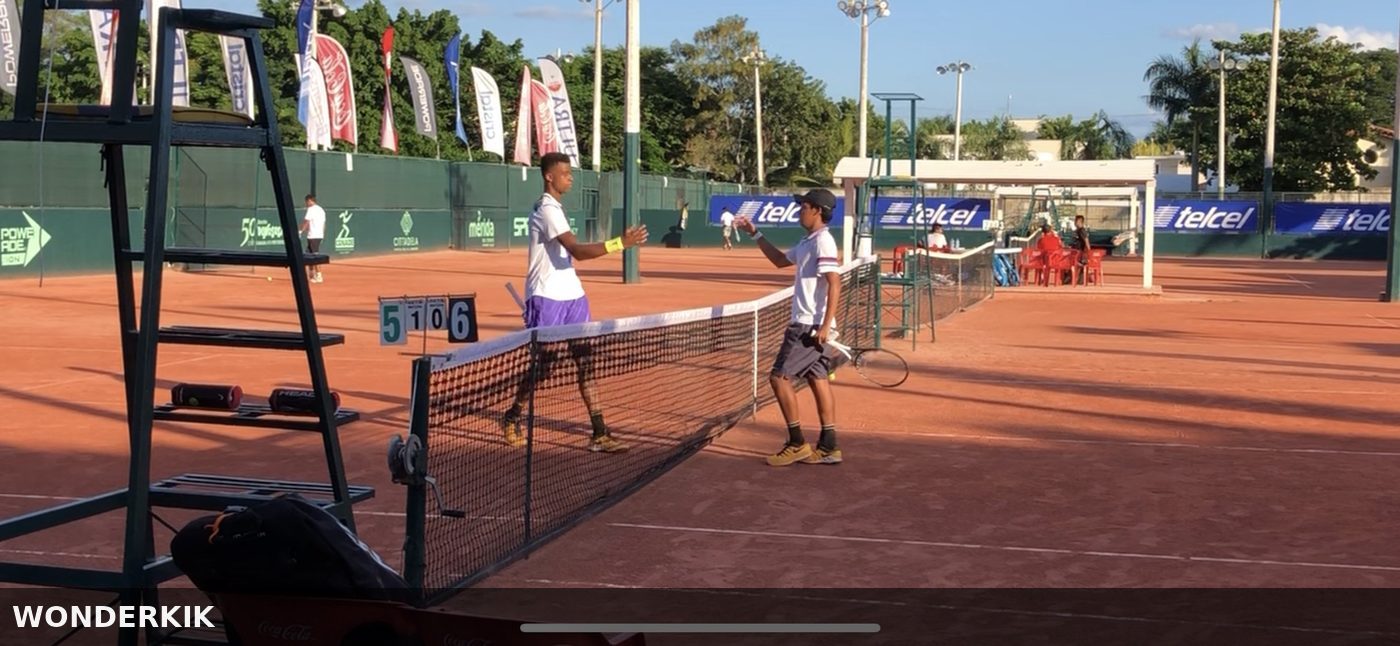
Match ends 6-3, 3-6, 7-6(4) — that little (4) in the third set is the tiebreak score, so 7-6(4) means “won the tiebreak 7 points to 4.” You’ll see that notation on every app and leaderboard on earth. Now you can read it.
Before every serve: call “server score, receiver score” — “30-40,” “love-30,” whatever it is, out loud. It settles the point before it starts, it settles any argument instantly, and it’s the habit every single beginner should build in week one.
Because deep down, everyone even slightly lost at tennis is really just lost at the scoreboard. You’re not anymore.
Racquet sports player and writer covering pickleball, padel, tennis, badminton, and squash. Former collegiate tennis player turned recreational pickleball enthusiast. Jackson writes beginner-friendly guides to help new players get on court faster.

















Recent Comments