Every tennis pro shop has a wall of rackets that look identical and cost from $35 to $400. The difference between these two price points for someone who has played for three months is close to zero — which is both the good news and the reason this guide exists.
You do not need the $250 Pro Staff matrix racket. You need a racket that fits your height, your grip, and your level — and the $120 racket does that just as well until your forehand is a known quantity.
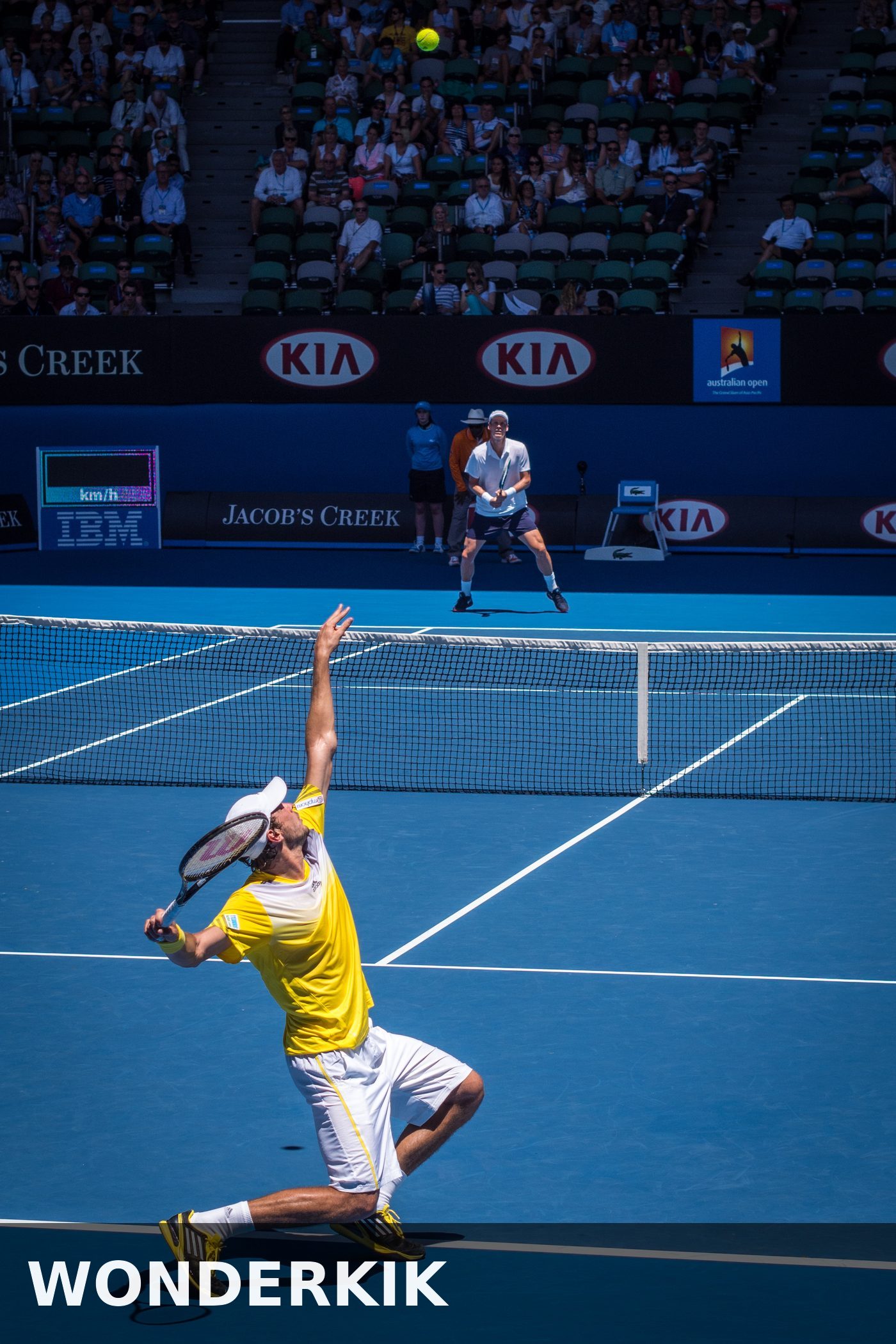
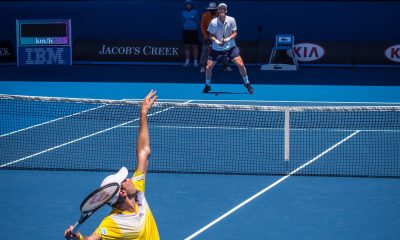
Guillaume Rufin serves to Tomas Berdych at Rod Laver Arena in the 2nd round of t – CC CC BY-SA 3.0 (Wikimedia Commons)
The three specs that matter
1. Head size: 100–110 square inches, that’s it
Beginner rackets come with oversized heads (up to 115 sq in) or mid-plus (around 100). Oversized gives you a bigger sweet spot — more forgiving when your contact point is a generous interpretation of “in front.” Midsize rewards the advanced player with control.
For your first racket: 100–108 square inches spend. On that window, frame choice matters far less than weight. If you’re picking purely by spec, mid-plus (100–102) tends to age the best — you won’t need to “grow out of it” the way the 115-inch rackets make you.
2. Weight: lighter than you think, heavier than you fear
First-racket weight ranges 255–300 grams (about 9–10.6 oz). The rule:
Under 270g: junior-fast, arm-risk low, great for kids, seniors, or recovering players.
270–290g: the adult beginner sweet spot. Light enough to swing all afternoon, heavy enough to actually hit a ball.
290g+: beginner “tour surplus” — heavier and stiffer, guaranteed to fatigue you before it teaches you anything.
The beginner trap is buying a heavy racket “to grow into.” Don’t. A racket you’re fighting in match three doesn’t make you better; it makes you injured. Keep it under 290g.
3. Grip size (the one people forget)
Grip size 0 to 4 (American sizing, 4 1/8 to 4 5/8 inches). The self-test: hold the racket in your non-playing setup — wait, the proper test — comfortable grip in the palm, and your ring finger’s pad should just touch your palm base. If your fingers dig into your palm, too small. If you can’t make the pad touch, too big.
Bigger grip = more wrist protection (less lever for force) but less spin flexibility. Smaller grip = spin-friendlier but risk of “white knuckle syndrome.” For most adults: 4 1/4 (size 2) or 4 3/8 (size 3), with 4 3/8 comfortable for most women and slimmer men.
Maltipoo and cavapoo running to return a tennis ball – CC CC BY-SA 4.0 (Wikimedia Commons)
Pre-strung: buy it pre-strung
For a first racket, buy pre-strung. The string world — tension, gauge, “poly vs synthetic” — is a second research project that doesn’t matter yet. Synthetic string at mid tension is right for 100% of true beginners. Re-string when the strings fray, not out of fashion anxiety.
How much should you actually spend?
Budget
What you get
Verdict
$30–60
Aluminum/plastic, heavy, dead feel
Fine for one summer, then not
$60–120
Graphite, pre-strung, light, forgiving
The sweet spot for your first racket
$120+
Tour-grade tech you won’t feel yet
Overbuying until you’re intermediate
A quality hand-me-down or a $80–100 graphite racket is the honest best-buy for a beginner. “Best” here means: you can swing it for 90 minutes, it forgives off-center hits, and you didn’t pay for a logo.
Famous first picks (why they’re first picks)
Two names you’ll hear a lot:
Babolat Pure Drive (mid-plus) — the most-played racket in amateur tennis, and it’s not close. Good power-to-control ratio, fine for beginners in the lighter versions.
Head Ti.S6 (oversize, ~115 sq in) — the classic forgiving oversized racket, ultra-light. The “barrier to entry” racket that keeps people playing.
Notice neither is top-of-the-line. They’re famous for being the boring reliable one — exactly the energy you want.
Decide $60–120. Choose mid-plus head (100–108) and 270–290g, pre-strung, grip 2 or 3 (test in a shop if you can). Ignore “pro,” “tour,” and “power” claims. Buy the racket you’re comfortable swinging, not the one that matches your idol’s sponsorship deal.
Then go play your first lesson with it. Once the racket stops being the variable, you’ll find out how fast you actually improve.
Racquet sports player and writer covering pickleball, padel, tennis, badminton, and squash. Former collegiate tennis player turned recreational pickleball enthusiast. Jackson writes beginner-friendly guides to help new players get on court faster.














Recent Comments