Squash scoring looks intimidating at first, but it is actually one of the simplest scoring systems in racket sport. Every rally scores a point, games go to 11, and matches are best of five.
The things people get wrong almost always come down to three details: the win-by-two rule (it only kicks in at 10-10), the fact that there is no cap on a game, and the old 9-point system you’ll still see written about online. This guide clears all three up.
Every rally scores a point — served or not. This is called PAR (point-a-rally) scoring.
A game is first to 11 points.
At 10-10 you must win by two — 12-10, 13-11, and so on, with no limit. Games have gone well past 20.
A match is best of five games — first to three game wins.
That’s the whole system. The rest of this guide is the detail underneath.
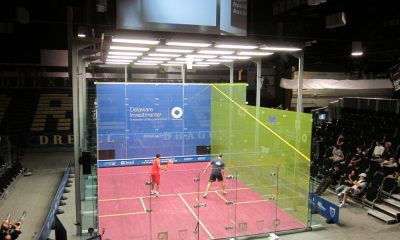
Bishop’s Stortford Squash & Racket Ball Club – CC CC BY-SA 2.0 (Wikimedia Commons)
PAR scoring, explained
“Point-a-rally” means the winner of a rally gets a single point, no matter who served.
If the server wins the rally, they score and serve again from the other box.
If the receiver wins the rally, they score and take the serve.
The result: every rally produces a point, games are fast and predictable in length, and squash became broadcast-friendly. That last point is exactly why the system was adopted.
The deuce rule: win by two or not?
This is the part that confuses most beginners, because it’s conditional:
Score is 11-9? Game over the moment a player reaches 11. No two-point margin needed.
Score reaches 10-10? Now you need to win by two clear points — 12-10, then 13-11, then 14-12, forever until somebody leads by two.
There is no cap in squash. A game at 10-10 can theoretically run to 30-28. In practice, deuce games are thrilling but short because the rally reward makes both players swing.
How the scoring changed (and why it matters for what you read online)
Squash was not always like this. Two older systems still show up in search results and old rulebooks, so you should know what they are:
Hand-in/hand-out (to 9). The original system. Only the server could score points. If the receiver won the rally, they just took the serve — the score did not change. Games went to 9 points. It made matches wildly unpredictable in length (a game could run 5 or 45 minutes) and boring to schedule for TV. That is why it was abandoned around 2009 in favour of PAR.
PAR to 15. An alternative scoring option officially allowed in the WSF rules for some competitions. Same idea as PAR but games go to 15. You might see it in certain leagues or older tournaments — but the standard everywhere today is PAR to 11.
The 2025 WSF Rules of Singles Squash (effective 1 September 2025) keep PAR to 11 as the standard: every rally scores, 10-all requires a two-point lead, matches are normally best of five.
Scoring the match: how it’s actually announced
In club play a Marker calls the score, server’s score first. You’ll hear calls like “Hand out, 4-3” (server lost the rally, new server, score tied after the changeover) or “Game Ball” when a player needs one point.
For casual play, don’t stress about perfect calls — just say both scores and whose serve it is.
Squash scoring vs your other racket sports
The fastest way to remember squash scoring is to compare it:
Pickleball: also first to 11, win by two, point every rally. Nearly identical skeleton — but squash has no second serve and no kitchen.
Tennis: games, sets, and 15/30/40 — completely different.
Do you have to win by two in squash? Only at 10-10. Below that, first to 11 wins.
How long is a squash match? Best of five games; the first to win three games takes it.
What’s a “set” called in squash? A game. Three games wins the match.
Does the winner always serve next? No — in PAR the rally winner always plays the next point, but they only serve if they were the server of that rally. Whichever player wins the point, the rally winner takes the serve.
Ready for the rules behind the numbers? Our beginner’s rules guide covers the serve, the tin, and lets vs strokes in ten minutes.
Racquet sports player and writer covering pickleball, padel, tennis, badminton, and squash. Former collegiate tennis player turned recreational pickleball enthusiast. Jackson writes beginner-friendly guides to help new players get on court faster.













Recent Comments