Squash is the racket sport you can learn in one session but spend years getting good at. It’s played by two players inside a four-walled court, hitting a small rubber ball against the front wall until one player fails to make a good return.
For a beginner, the game is not complicated. There are four rules you need first — the serve, the return, the “good return” rules, and how you win a point. Everything else is fine print.
If you’ve never played, here is the version that gets you on court today.
Odense Squash Klubs finalehold medaljeslutspil 2008 – CC CC BY-SA 4.0 (Wikimedia Commons)
The squash court in one glance
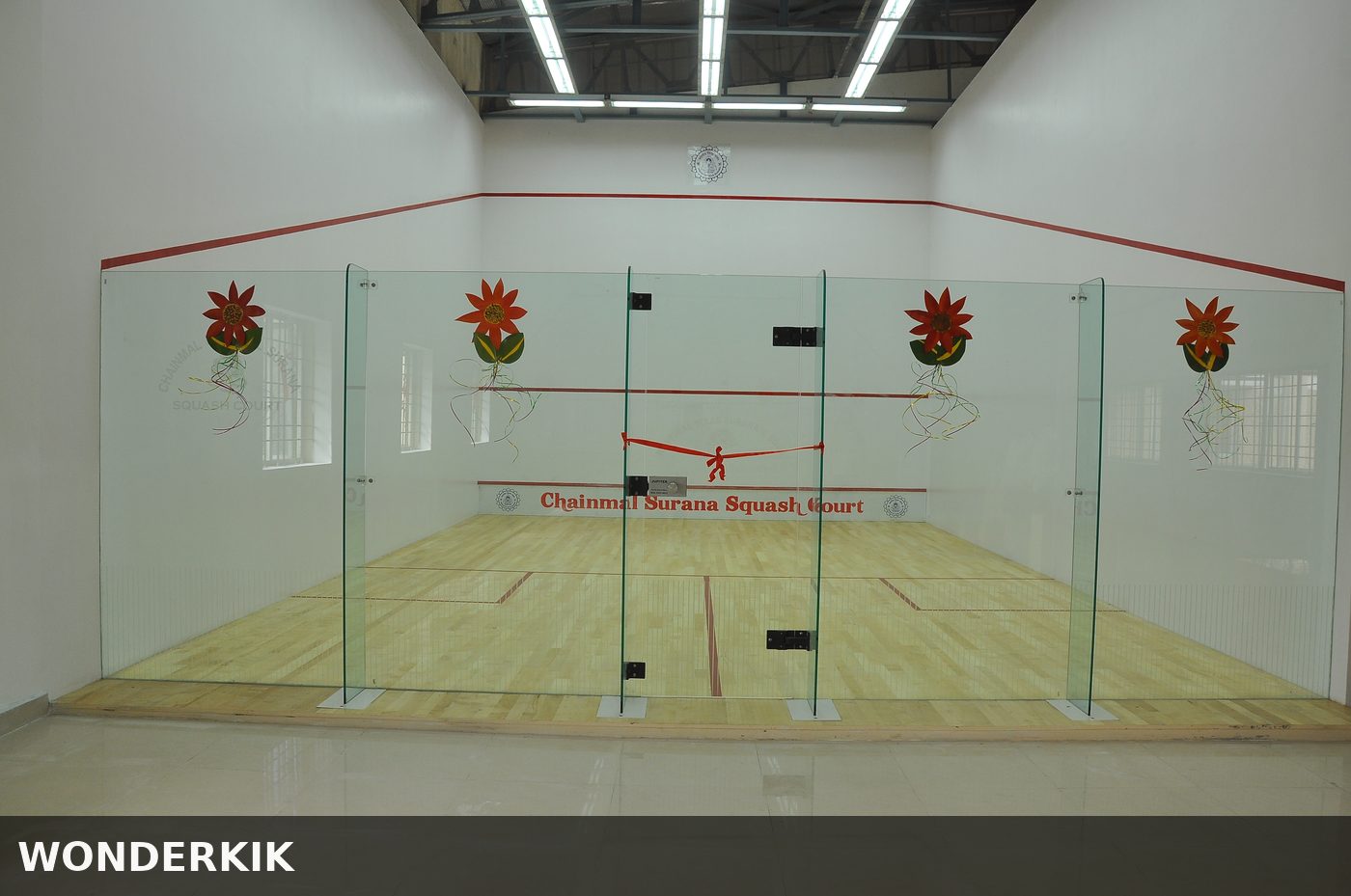
Before the rules make sense, know the court. A standard singles court is a rectangular room, about 32 ft (9.75 m) long and 21 ft (6.4 m) wide, enclosed by four walls.
Three walls matter for marking:
Front wall — the main target. It has three lines: the service line, the out line, and the tin at the bottom.
The tin — a hard strip at the bottom of the front wall, about 19 inches (48 cm) high. Hitting below the tin is out.
Back and side walls — carry the out line, which runs around the court at the height of the front wall line.
On the floor there’s a short line halfway back, a half-court line down the middle, and two service boxes. The best position to stand is at the T, where the lines cross in the middle.
Main clubhouse of the Durban Country Club (DCC) in Stamford Hill, Durban, eThekw – CC CC BY-SA 3.0 (Wikimedia Commons)
Rule 1: The serve
The serve is the most technical part of squash, and there is only one of them.
You serve from inside one of the service boxes, with at least part of one foot planted until the ball hits the wall.
The ball must hit the front wall first, above the service line and below the out line.
It must then land in the opposite back quarter of the court.
Win the point on your serve and you serve again, from the other service box. Lose the point and your opponent takes the serve.
There is no second serve — screw one up and the point is gone.
Rule 2: The return
After the serve, players hit the ball alternately. If the server’s shot comes to you as the returner, you must hit the ball to the front wall before it bounces twice.
The ball may hit the side or back walls any number of times, and it may bounce once on the floor — but it must reach the front wall before the second bounce, and it must hit the front wall above the tin and below the out line.
Rule 3: The good return
Once the ball is in play, the same rules apply to every shot:
The ball must be struck before it bounces twice.
It must make contact with the front wall before it hits anything else after your shot — in practice, you aim it at the front wall first.
You may use the side and back walls to change the angles (this is called a boast when you play a side wall first).
You can also volley — hit the ball on the fly before it bounces.
Hitting the tin, hitting above the out line, or double-hitting the ball (a carry) all lose you the point.
Rule 4: How you win a point
Squash uses PAR (point-a-rally) scoring:
Every rally wins a point, whether you served or not.
Games are first to 11 points, and if it reaches 10-10 you must win by two clear points (12-10, 13-11, and so on — there is no cap).
Matches are generally best of five games — first to win three games takes the match.
Under the old hand-in/hand-out system, only the server scored, and games went to 9. That changed in 2009, and the 2025 World Squash rules confirm PAR to 11 as the standard for every level.
Let, no let, and stroke
Three words you will hear from your first rally:
Let — you stop play because your opponent got in the way and you could not safely play the shot. The rally is replayed. Nobody scores.
Stroke — your opponent blocked your shot and you could not play it. You win the point.
No let — the referee decides you were not blocked. The rally stands and your opponent gets the point.
For beginners the simple version: if you stop because you nearly hit someone, call a let and replay it. Safety first, always — squash is a confined space and the racket carries a lot of momentum.
You do not need to own anything to try squash — clubs rent it all. Four things matter:
A squash racket — lighter than a tennis racket, typically 110–170 g. Rent first, buy later (we have a full weight chart in the racket guide).
A fast squash ball — the black one with a single yellow dot is the standard. For beginners, a blue or red-dot ball bounces more and keeps rallies going.
Non-marking shoes — with a light-coloured sole. These are mandatory at nearly every club.
Eye protection — worth wearing in a confined court where balls fly fast.
If you want more detail on the numbers before you go, our scoring guide walks through PAR 11 and the tiebreak in plain English.
Portions of the rules above follow the World Squash Federation (WSF) Rules of Singles Squash, effective 1 September 2025.
Racquet sports player and writer covering pickleball, padel, tennis, badminton, and squash. Former collegiate tennis player turned recreational pickleball enthusiast. Jackson writes beginner-friendly guides to help new players get on court faster.


















Recent Comments