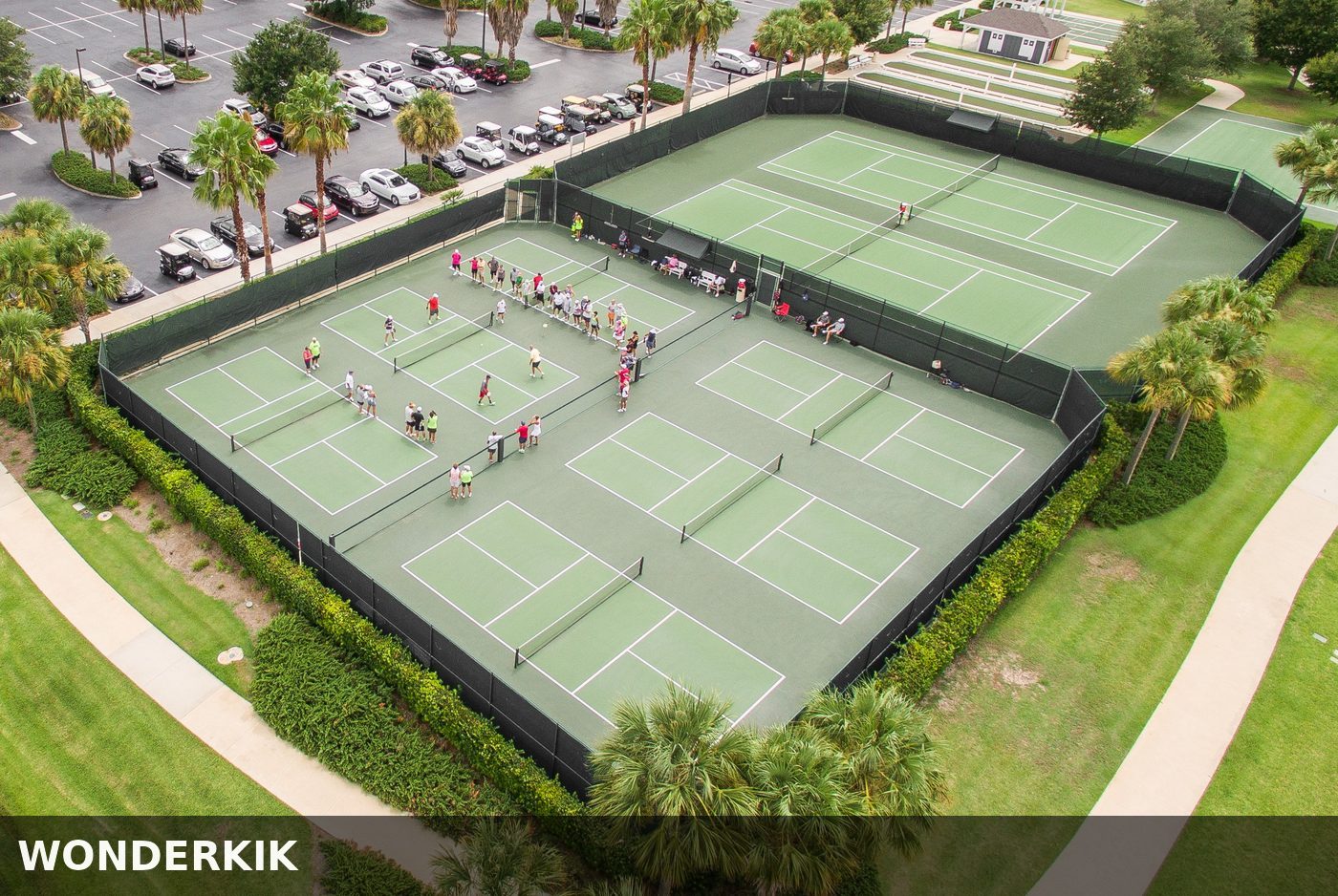
Pickleball looks like tennis and ping-pong had a baby that moved to the community center. Two (or four) players, a whiffle-style plastic ball, and a court about half the size of a tennis court. You can learn the flow in one afternoon — most people do.
Here’s how to play pickleball from that first serve to the last point, without the jargon.
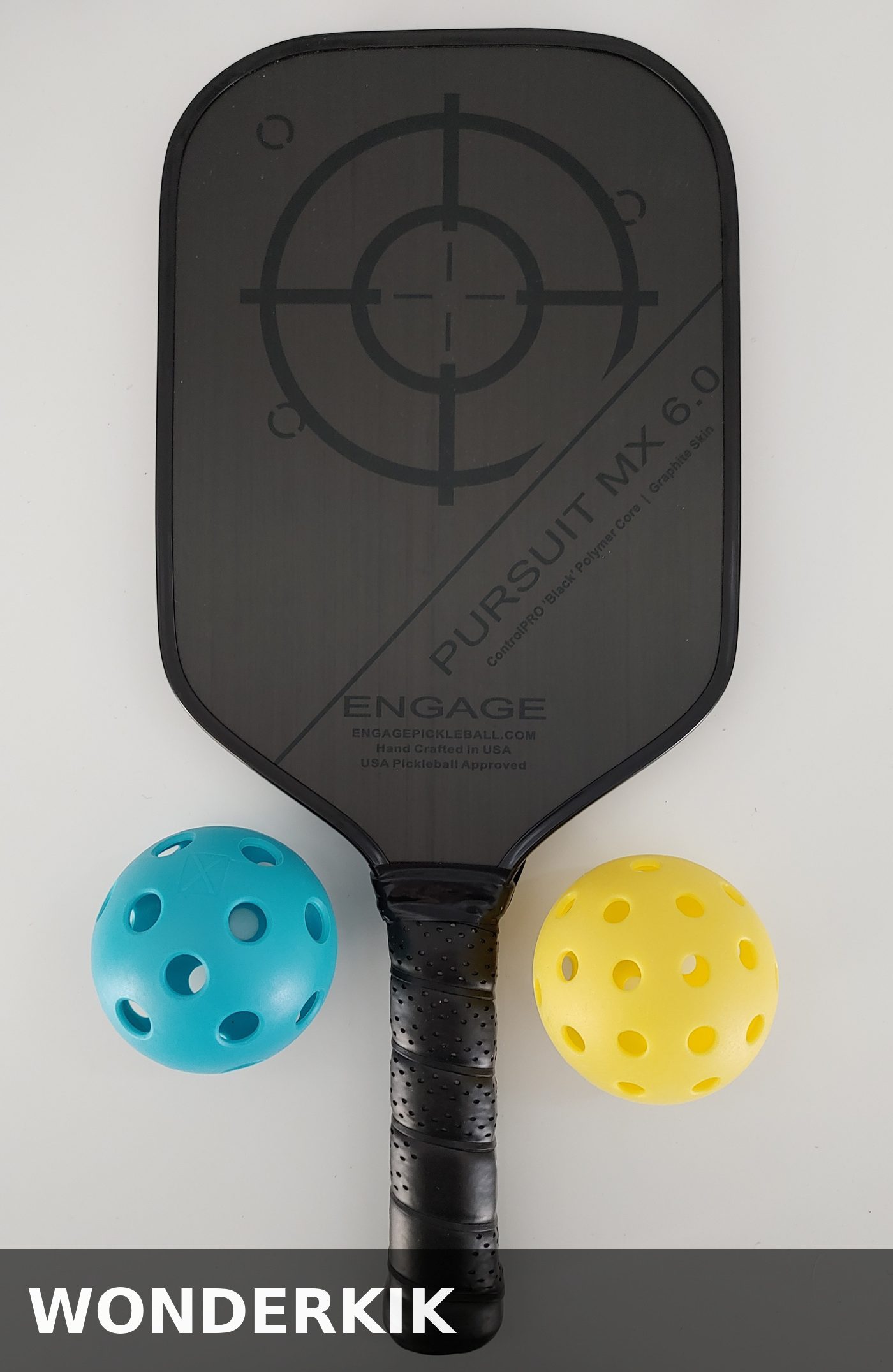
A Pursuit MX 6.0 pickleball paddle by Engage with one blue indoor pickleball and – CC CC BY-SA 4.0 (Wikimedia Commons)
The short version
You serve underhand from behind the baseline.
The ball must bounce once on each side before anyone can volley it.
The kitchen (the 7-foot zone by the net) can’t be volleyed from.
Play to 11, win by 2.
The ball is out of bounds if it lands outside the lines or hits the net on your side.
That’s the whole game. Everything else is skill.
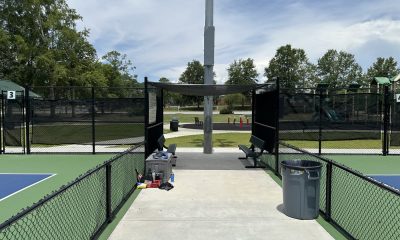
Located in between pickleball courts 3 and 4 at Harry B. Anderson Tennis Center – CC CC0 (Wikimedia Commons)
The serve: the only overhead rule is “no overhead”
Pickleball serves are underhand, period. The paddle has to swing below your waist, and the ball has to come off the paddle face below the waist too. You serve diagonally (like tennis) to the opposite service court, and the serve must clear the kitchen and land beyond it — otherwise it’s a fault.
Big practical tip: you’re serving into the receiving court behind the kitchen line. A ball that lands in the kitchen on the serve is out, even if it’s inside the baseline. Once the serve lands, the receiving side lets it bounce once before returning.
The double bounce rule: the sport’s most confusing rule
For the first two shots of a rally, the ball must bounce. Here’s the sequence:
Server serves the ball.
Receiver lets it bounce, then returns it.
The server’s team now lets that return bounce before hitting it.
After those two bounces, either team can volley — or let it bounce — however they like.
New players get this wrong constantly for the first few games. The way to remember: the serve bounces, the return bounces, then it’s loose. Watch any beginner gym simply forget step 3 and you’ll see why this rule exists — it’s what keeps tall, hard-hitting servers from dominating.
The kitchen: no-volley zone with a stern name
The kitchen is a 7-foot strip on both sides of the net. You can’t stand in it and hit a ball in the air (volley), but you can step into it after the ball bounces. The rule exists to stop players from parking next to the net and smashing everything down.
The common mistake: stepping into the kitchen after volleying, carried by momentum. The rule is about where your feet are when you hit. Stepping in after the hit is fine. If either foot touches the kitchen while you volley, it’s a fault.
What actually happens in a point
A typical rally plays out like this:
Serve to the diagonal court; server’s side can only get points they’re serving for.
After the two mandatory bounces, players dink (soft shots into the kitchen), drive (harder shots), or lob.
Points end when the ball hits out, hits the net, bounces twice, or someone volleys from the kitchen.
Only the serving team scores. If the receiving team wins the rally, they earn the serve back — not a point.
Scoring in 30 seconds
Scores are announced as three numbers: server’s score, receiver’s score, then a third number showing which server (one or two) is serving. You win a game at 11 by 2 — no upper cap if it goes to 11-10, keep going to 12-10. This confuses everyone on day one, and our pickleball scoring guide breaks it down to the point where it makes sense.
Gear you actually need
Realistically: a paddle, a ball, and court shoes you don’t care about. Brands matter later. For your first weeks:
A recreational paddle in the $40–80 range is plenty — our paddle guide walks you through what weight and grip do.
Use an outdoor ball on outdoor courts — they’re heavier and stand up to wind better.
Court shoes beat running shoes because you shuffle and lunge sideways constantly.
Where to play
Most parks don’t require reservations for a public court — show up, and if it’s busy, the pickleball etiquette is a paddle-on-the-floor rotation system when there’s a queue. Call fun, call lines honestly, and let beginners hold their own space. It’s the most forgiving intro to a racket sport you’ll ever have.
How to get better fast (three hacks)
Dink first, drive second. Beginners win points by being patient at the kitchen line, not by swinging hard.
Watch your partner’s position. Pickleball doubles is about covering gaps; stand diagonally-cornered from your partner so the court isn’t open down the middle.
Master the third shot. The third shot of the rally (after the two bounces) is usually a drop shot into the kitchen — get that soft and you’ll control the game.
Yes. The kitchen rule only bans volleying from inside it. If the ball bounces in the kitchen, step right in and hit it.
How is pickleball different from tennis on day one?
The underhand serve, the double bounce rule, the kitchen, and the smaller court. Tennis rewards power and reach; pickleball rewards placement and patience. Our pickleball vs tennis breakdown covers the full comparison.
Do you need to be fit to play pickleball?
Not really. That’s the point. You can play at walking intensity your first year; tournament-level pickleball is athletic, but casual play is genuinely accessible.
How long does a pickleball game last?
A game to 11 usually runs 15–25 minutes. League play is often best-of-three, which lands around an hour.
Racquet sports player and writer covering pickleball, padel, tennis, badminton, and squash. Former collegiate tennis player turned recreational pickleball enthusiast. Jackson writes beginner-friendly guides to help new players get on court faster.














Recent Comments