If you’re about to mark out a pickleball court in a driveway, a park, or a community hall, you need the numbers exact — not “roughly.” A net an inch low, a kitchen line a foot deep, and suddenly every serve and every dink argument has a wrong answer written into the floor.
Good news: pickleball is the smallest of the racket sports, which makes it the easiest to mark. Here are the exact official dimensions, plus a walkthrough for doing it yourself.
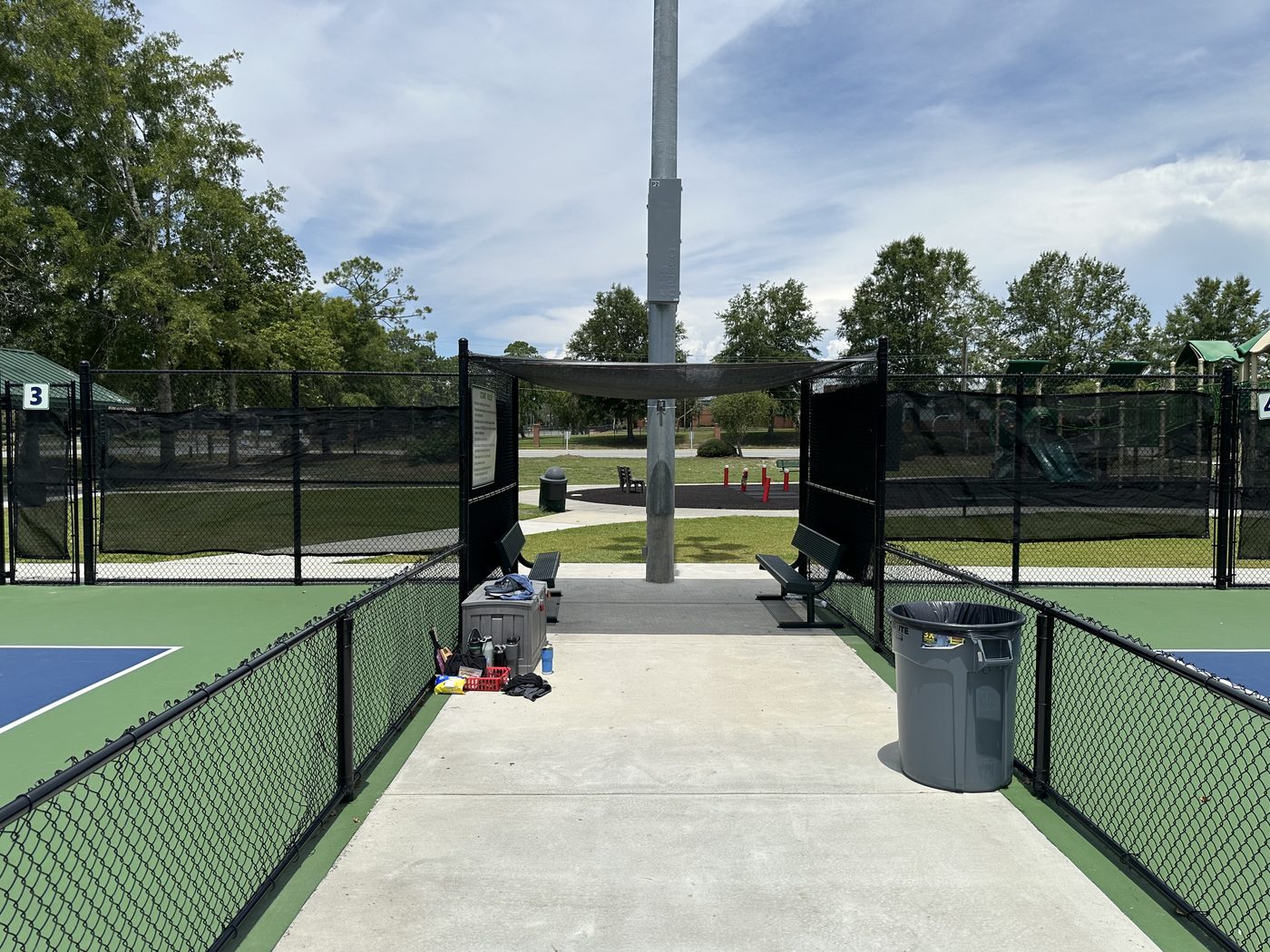
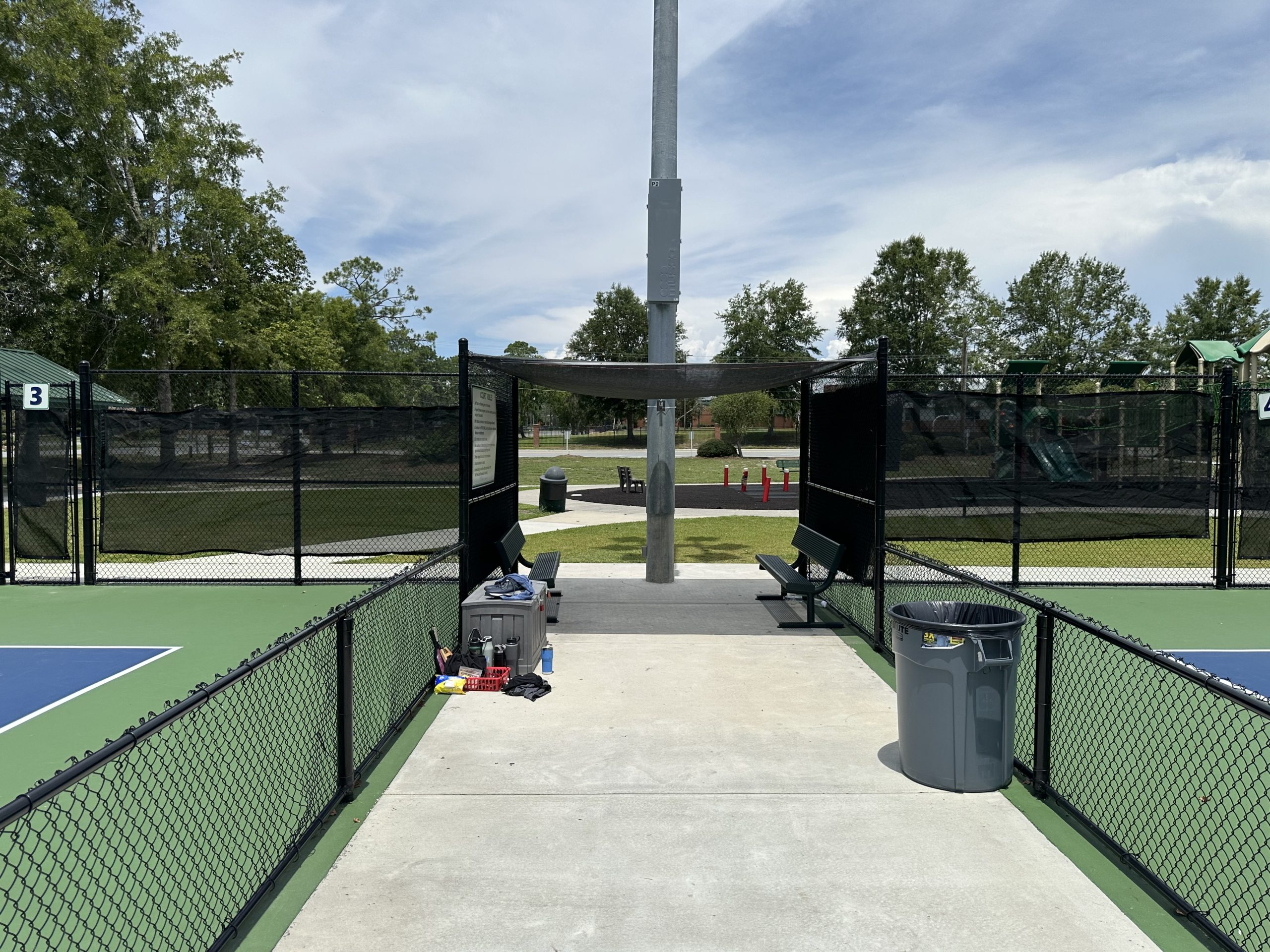
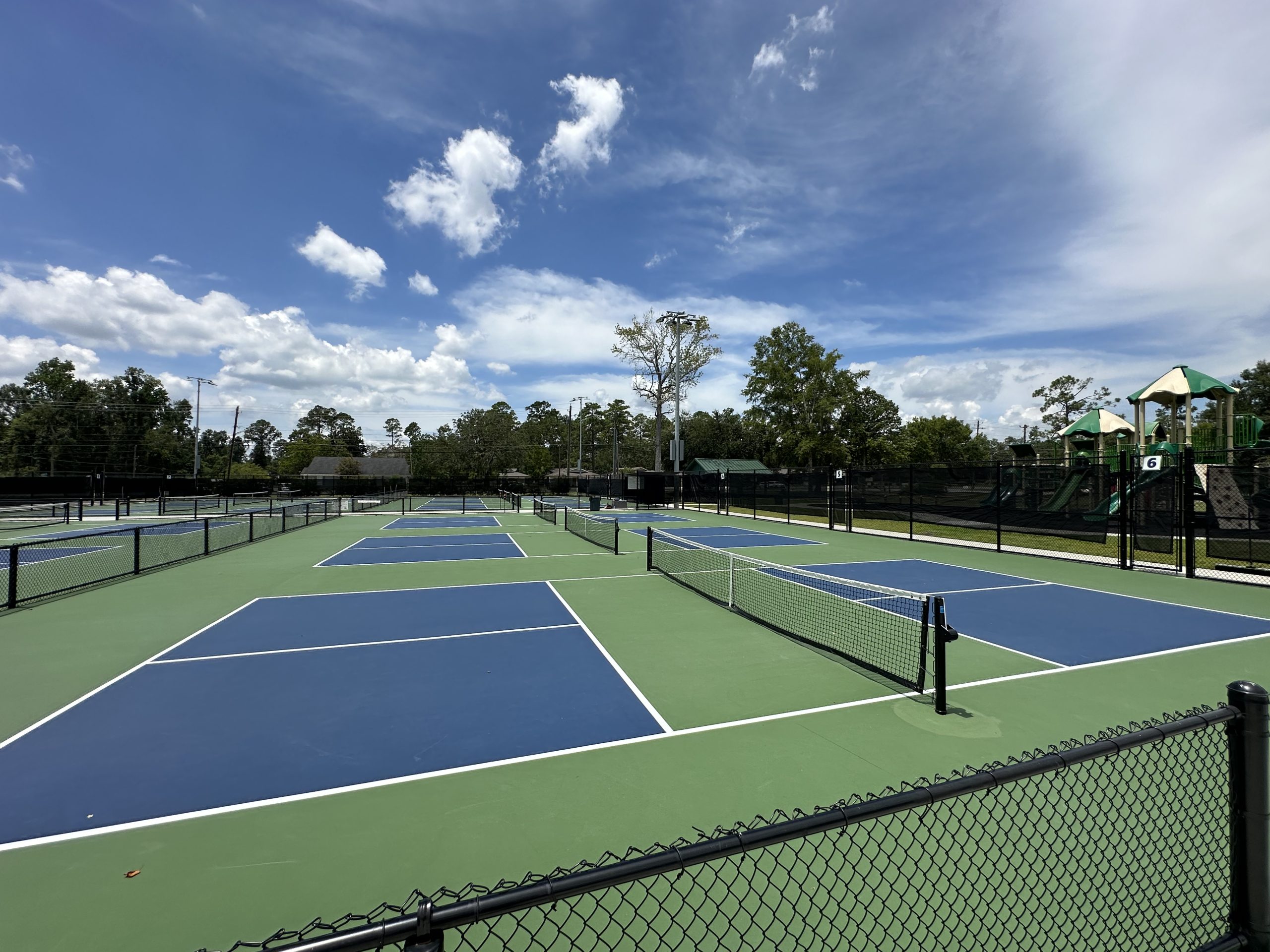
Located in between pickleball courts 3 and 4 at Harry B. Anderson Tennis Center – CC CC0 (Wikimedia Commons)
The non-negotiables at a glance
Element
Official measurement
Court length
44 feet
Court width
20 feet
Non-volley zone (the “kitchen”)
7 feet deep on each side of the net
Net height at posts
36 inches (at the sidelines)
Net height at center
34 inches
Service line distance
15 feet from the net (i.e., lines run 10 feet from the kitchen boundary)
Center line
10 feet long, from kitchen line to baseline, splitting each service area
Equal court on both sides of the net — always 22 feet each half. Exact, every time.
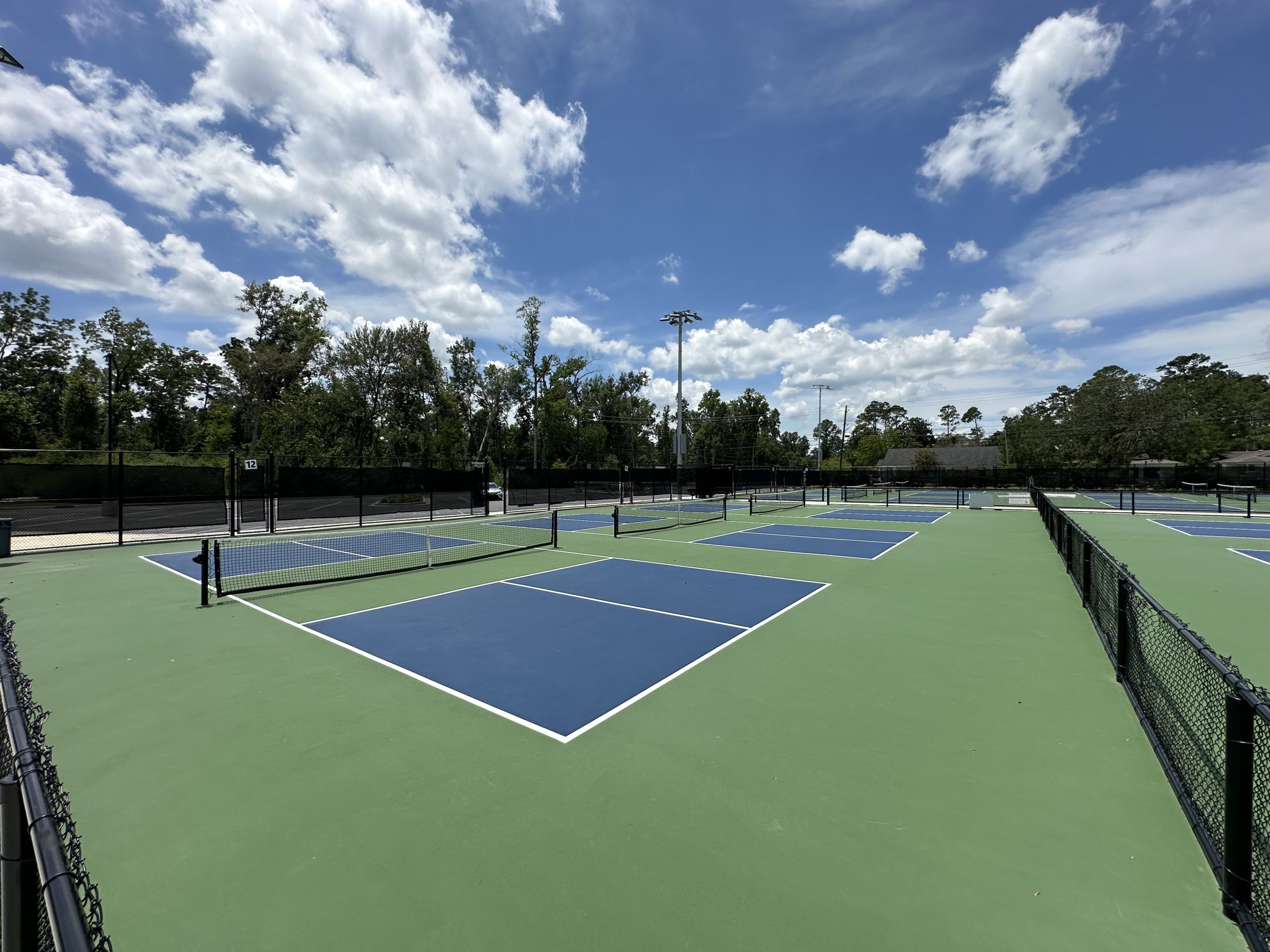
A Fair-way SE versenyzői edzést tartanak. – CC CC BY-SA 4.0 (Wikimedia Commons)
Breaking the court down
Starting from the net and moving back:
The kitchen (non-volley zone) — 7 feet deep, running the full 20-foot width, on both sides. A serving ball can’t touch it. A player standing in it can’t volley. When you mark it, include the line as part of the kitchen: the kitchen line is in, and it’s the number-one source of beginner confusion.
Service boxes — from the kitchen line back to the baseline, the court splits into two 10×10-foot service boxes, divided by a center line down the middle. Serves land diagonally into these.
Baselines — the back lines, 22 feet from the net. Serves happen behind these.
Sidelines — 20 feet apart, running the full 44 feet.
Every line except the center line’s extra markings is the standard 2-inch width, and all lines are measured to their outside edge — which is the technical way of saying “a ball touching any part of the line is in.”
What you need to mark a court yourself
Court surface: 44×20 feet of flat, hard surface. Driveways, parking lots, community courts, gym floors. With four-plus centimeters of padding if you’re doing it indoors. If you don’t have 44 feet, you have a driveway version — more on that below.
Tools for a temporary court:
– Chalk or removable tape for parking-lot marking (cheap, temporary, works fine for learning).
– Water-based paint if it’s a permanent driveway court. Use a 2-inch roller to keep lines even.
– Four corner stakes + a long tape measure to get the corners square.
– A portable net that goes to 34 inches at center and 36 at the posts.
The squareness trick: measure both diagonals. A perfect rectangle has equal diagonals; if yours differ, nudge your stakes until they match. (44² + 20² = diagonal², so the diagonal is exactly 48.33 feet — measure 48 feet 4 inches corner to corner.)
The two-of-them trick for the net
Set the net height at 36 inches at the posts and 34 inches at center. The sag matters. A tight, over-taut net sits high at center, bounces judgy; a saggy net drops under 34 and every dink suddenly clears it by miles. Use the two rules: measure at the posts, then check center. Adjust the center strap slowly — tiny turns change the bounce more than you’d think.
What about a “half court” or small space?
No official half-court exists for singles — pickleball has no sanctioned singles court. But if you’re adapting:
Smaller court (20×40): standard width, remove 2 feet from each end of the kitchen-to-baseline area for casual play. Optional, nobody’s coming to measure you at the barbecue.
Driveway court: If you have 20 feet of width but not 44 of depth, mark a tight 36–40 foot court for drills — serve from behind whatever becomes your line. It teaches aiming, which is court dimension standard anyway.
The difference between a frozen-lake-ice game and a driveway game is mostly the surface, not the numbers.
Why these exact numbers exist
44×20 keeps it half a tennis court. The 7-foot kitchen keeps the volley zone honest. The 34-inch center net makes dinks the sport — a 40-inch net would turn every bounce into a skyball. The sport was invented in 1965* by a dad with a badminton court, a ping-pong paddle and a whiffle ball; the dimensions have aged into a regulation standard precisely because they’re small enough to fit anywhere and math-hard to get wrong.
Enjoy marking it, even the arguing-about-the-diagonal part. Every centimeter of correct line is a serve dispute you never have.
Reading Next
Related guides from the WonderKik racket-sport series:
A Pursuit MX 6.0 pickleball paddle by Engage with one blue indoor pickleball and – CC CC BY-SA 4.0 (Wikimedia Commons)A Pursuit MX 6.0 pickleball paddle by Engage with one blue indoor pickleball and – CC CC BY-SA 4.0 (Wikimedia Commons)Pickleball Paddle – CC image (cc0) via Openverse
Pickleball looks easy from the stands. Two people hitting a plastic ball over a low net on a court about half the size of a tennis court. And honestly, it kind of is easy — that’s why it’s the fastest growing sport in America. But if you show up to a public court without knowing the rules, you’ll spend your first hour getting gently corrected by strangers holding paddles.
So let’s skip that. Here’s everything you actually need to know before your first game, minus the jargon.
The court, quickly
Pickleball is played on a court that measures 20 feet wide and 44 feet long — the exact same size as a doubles badminton court. The net sits at 36 inches at the edges and dips to 34 inches in the middle.
There’s one zone that matters more than anything else: the non-volley zone, usually called the kitchen. It’s the 7-foot band on each side of the net. If you’re standing in the kitchen, you’re not allowed to hit the ball in the air. The ball has to bounce first before you can hit it while standing in there.
The baseline is where you serve from. There’s also a centerline and two service courts, but we’ll get to that when we talk about serving.
The Golden Rule: the double bounce
Here’s the rule that trips up almost every beginner.
When a team serves, the receiving team has to let the ball bounce once before they return it. Then the serving team also has to let it bounce once before they hit it back. So the first two shots of every rally — the serve return and the third shot — must bounce.
After those two bounces, everything is fair game. You can step up and volley the ball straight out of the air if you want, as long as you’re not in the kitchen.
This is called the two-bounce rule, and it’s why you’ll hear people talk about the “third shot drop.” The third shot is usually a soft shot that lands in the kitchen so the serving team can move up to the net.
How serving actually works
The serve is the most complained-about skill in the whole sport, mostly because of two rules people don’t believe at first:
It’s underhand. Not a tennis serve. Ever.
No bounce. You hit the ball out of the air, not after a drop-bounce.
The contact point has to be below your waist, and the paddle head has to be below your wrist when you hit the ball. The motion is a swing from low to high — think of it like bowling but upward.
You serve diagonally to the opposite service court, and the ball has to clear the kitchen. It can’t land in the non-volley zone, and it can’t land on the kitchen line, because that line is part of the kitchen.
Wait for the referee in your head: when you serve and the ball lands, the receiving team lets it bounce, returns it, and then your team lets that bounce before hitting the third shot. Once the third shot lands, rally play begins — up to the net you go.
Scoring without losing your mind
Here’s the version of scoring that everything else is built on:
Games go to 11 points.
You have to win by 2.
Only the serving team scores. If the receiver wins the rally, they don’t get a point — they just get the serve back.
That last one confuses people who’ve played volleyball. In pickleball you can’t score on rallies you didn’t serve, so serving is everything.
The serve itself alternates sides within your team. You serve from the right side when your score is even, and the left side when your score is odd. Each team gets two serves before the serve passes to the other side — one for each player — except at the very start of the game, when the serving team only gets one serve.
The score is called as three numbers: your score, their score, then which server you are (one or two). So “six, four, two” means you’re winning 6-4 and it’s the second server’s turn. Listen for it on public courts — it sounds intimidating for a week and then it becomes automatic.
What counts as a fault
A fault ends the rally. The most common ones:
Hitting the ball into the net
Hitting it out of bounds
Stepping into the kitchen (or on the line) while volleying
Volleying the ball before it bounces during those first two shots
Serving into the net, into the kitchen, or out of bounds
Hitting the ball off the court and into someone’s coffee (this isn’t in the rulebook but it happens)
That’s basically it. There’s no “jail,” no penalty box, no fouls called like in basketball. Fault means the rally’s over, and if you were serving, the serve moves either to your partner or to the other team.
One more thing: reach and line calls
Lines count as in. If the ball lands on any part of the line, it’s good — that includes the kitchen line for serves, which catches beginners out all the time.
And the buddy rule: the player closest to the ball makes the call, not the player who hit it. When in doubt, it’s in. There are exactly zero people who became pickleball legends by arguing line calls.
Your first game in one paragraph
Serve underhand, diagonally, from the right side when your score is even. Let the return bounce, let your team’s third shot bounce, then move up and try to keep the rallies going with soft dinks into the kitchen. Don’t volley from inside the kitchen, call the lines honestly, and play to 11. Whether you win or lose, you’ll way more likely pick up the game in one afternoon than you would with golf.
Now go grab a public paddle and a court with a friendly group of strangers. That first serve isn’t going to hit itself.
Reading Next
Related guides from the WonderKik racket-sport series:
This sign is affixed to the exterior of the fence surrounding pickleball court 3 – CC CC0 (Wikimedia Commons)This sign is affixed to the exterior of the fence surrounding pickleball court 3 – CC CC0 (Wikimedia Commons)Photo taken from the east side of the courts facing west, this image is of pickl – CC CC0 (Wikimedia Commons)
Your first time on a public pickleball court, you’ll hear someone shout “six, four, two” before every serve. It sounds like a secret code until somebody explains it, and then it’s obvious. This is that explanation — the version you’ll actually remember.
Pickleball scoring is only confusing for about twenty minutes. Here’s the whole thing, in the order you’ll need it.
The three things that matter
Games go to 11 points
You have to win by 2
Only the serving team scores
That third one is where everyone gets lost, because it’s backwards from most sports. In pickleball, you can’t score a point when you’re receiving. You win the rally, you get the serve back — not a point. When you serve and win the rally, you get both a point and keep serving.
Why the score is three numbers
The score is always called as three numbers: your score, their score, then which server is serving (1 or 2).
So when somebody hollers “six, four, two,” they mean: we have 6, you have 4, and I’m the second server. If it’s a doubles game, and it almost always is, this makes sense — each team serves twice before the serve passes over, once for each player. Calling out which server is up stops your team from hitting a rally on the wrong turn.
At the very start of a game, the serving team only gets one server turn. That’s the one exception, and it’s basically a handicap so that the first serving team can’t run away with the game before the other side ever touches the ball. Nobody ever remembers this rule, and that’s why the opening serve is always a little awkward for someone.
Which side do you serve from?
The rule sounds formal but it’s simple: serve from the right when your score is even, and from the left when your score is odd.
Score 0? Even. Serve right. Win the point, score becomes 1? Odd. Next serve from the left. Lose the rally at 1? The serve goes to your partner, who serves from the right (score is still 1 — odd — wait, no).
Careful, this trips up even veterans. When your partner takes over, their side is determined by the same rule, but it’s the team score that matters, and the server changes. If your score is 1 (odd), the second server serves from the left. If your score is 2 (even), from the right.
Here’s the easy mental shortcut: ignores who the person is — the starting side is fixed by the score. Right for even, left for odd, full stop. Once you stop thinking about “which player” and just think about the number, it clicks.
What happens when the serving side faults
The serve doesn’t just hand over immediately. Here’s the sequence:
First server plays a rally and loses → serve moves to your partner (second server)
Second server loses → serve passes to the other team, who now serves
The other team’s first server plays, then their second server, then it comes back to you
So the “side out” only happens every two serves. Your team scores, keeps serving, and your server position just keeps alternating based on the score.
What about a tie at 10?
Martina vs. everyone: you need to win by two. If it’s 10-10, the game doesn’t end at 11. You play until somebody is up by two — 12-10, 13-11, 14-12. Capeesh? Games can go long, and that’s exactly why the two-serve rotation exists.
During a win-by-2 streak, the serve keeps alternating sides on every point the serving team scores. The receiving team stands wherever they’ve been standing; the scoring just keeps climbing until the two-point gap appears.
The paddle trick most people don’t know
This is the tip nobody gives you: many players tap the edge of their paddle with their free hand between points. It’s not a superstition — it’s how they mark their own score so they don’t lose track mid-game. (Tap once per point.) It looks strange on TV until you know what it is, then you’ll see it everywhere.
Also, the rule is simple enough to say out loud: each player tracks their own team’s score, and the server announces it before they serve. If the score’s announced wrong and people don’t object before the serve, the wrong score sticks. So keep an ear out even when you’re not playing.
You’re ready for tournament play (of the casual kind)
That’s genuinely the whole scoring system. No deuce, no advantage, no love — none of that tennis stuff. Eleven points, win by two, score on your serve only, right for even and left for odd, and each team serves twice per rotation except at the very start.
Next time someone on court calls the three-number score, you’ll be the one who nods like you’ve done this a hundred times. And honestly? By game two, you will have.
Reading Next
Related guides from the WonderKik racket-sport series:
Photo taken from the east side of the courts facing west, this image is of pickl – CC CC0 (Wikimedia Commons)Photo taken from the east side of the courts facing west, this image is of pickl – CC CC0 (Wikimedia Commons)This photo shows team leader of Team North America, Marcin Rozpedski, holding th – CC CC BY 2.0 (Wikimedia Commons)
There are probably two hundred pickleball paddles on the market right now, spread across about twenty brands, and nearly all of them cost more than you want to pay. The catalog is overwhelming on purpose. Rack up a search for “best pickleball paddle” and you’ll drown in sponsored lists of expensive composite paddles with a stranglehold of marketing terms attached.
Here’s the thing: choosing a paddle isn’t actually that deep. It’s three numbers and one honest conversation about your body. Learn those, and the marketing noise disappears.
The three numbers that decide everything
1. Weight — the most important, least discussed
Every paddle falls into one of three buckets:
Light (6.5–7.3 oz) — fast swing, easy to control at the net, easier on the shoulder. Sacrifices power.
Mid (7.5–8.3 oz) — the all-rounder most players end on. Balance of power and control.
Heavy (8.4+ oz) — more plow-through on the ball, more power, but your arm feels it in the third game.
If you’ve never owned a paddle, start mid (around 7.8–8.0 oz). You’ll feel what you need more of within a month — and your next paddle will be a more informed decision. If you’re a senior player or coming back from a shoulder issue, go light. If you’re a strong, aggressive player who hates blocked shots, lean heavy.
The honest test: hold one of each weight in a store and swing them fifteen times, not three. The one your arm doesn’t complain about after fifteen swings is the one.
2. Face material — where the marketing lives
Paddle faces come in three real materials:
Plastic/beginner (polypropylene or similar composite) — $25–60. Slow, dampened feel. Totally fine for your first six months.
Graphite/fiberglass — $80–140. Lighter, more pop, crisper feel. The sweet spot for most club players, value-wise.
Raw carbon fiber — $140–280. Tournament-grade spin and responsiveness. Worth it only if your game already demands it.
Ignore everything that says “aerospace,” “pro,” or “tour” on a paddle under $100. If they were handing out free wins, they wouldn’t be charging $80 for them.
3. Grip size + length
Grip matters more than you’d think and less than the internet says. Rule of thumb: with the paddle facing up, your middle finger should just touch the palm of your hand when you wrap. A grip that’s too small makes you squeeze harder and wheres out your forearm fast.
Paddle length is simpler: 15.5–16 inches. Longer = more reach for dinks and reset; shorter = more maneuverable at the kitchen line. Unless you’re a 6-foot-tall kitchen troll trying to reach everything, standard length is fine.
The two questions nobody asks you
What level are you actually at?
Not “what level would you like to be,” the level you are today:
New player (first 6 months): a mid-weight, polymer-faced paddle under $80. An expensive paddle won’t fix bad technique.
Club regular: graphite or fiberglass, mid-weight, $90–150.
Tournament hopeful: start raz-KA-ling about carbon fiber only once your tournament results say you need it.
How’s your arm?
Shoulder rotator, tennis elbow, or general middle-aged arm complaints — and let’s be honest about demographics — point you to light-weight (under 7.5 oz) and a larger grip. There’s good evidence that a bigger grip, not a bigger paddle, is what protects your elbow. A 4.25-inch grip costs you nothing and might save you a year of clicking.
What to skip entirely (the traps)
“Limited edition” faces in exotic colors with “one-of-a-kind spin” — spin mostly comes from the ball, then from technique, then from the paddle. Real order, sorry.
Paddles with huge sweet-spot claims — every paddle claims this.
Anything you’re buying to match your Instagram feed. Buy for your arm.
A price-aware buying flow
Decide your budget before you look. $60–90 is the honest sweet spot for a first quality paddle.
Pick weight mid (7.8–8.0 oz).
Pick face: polymer for your first, graphite for your second.
Grip size: 4.25 if you’re unsure; smaller if you have small hands.
Read two reviews, not twenty. Trust the one that talks about weight.
That sequence will land you in the right 85% of paddles for your game within half an hour. The remaining 15% is feel — and only time on court gives you that.
Your first paddle should be boring
Honestly, the best first paddle is a plain mid-weight polymer with a standard grip. It won’t win you an award on a forum, it won’t be in a sponsored list, and it will do exactly what a paddle is supposed to do: not get between you and the ball.
After a few months, when your dinks land where you want, your drives carry, and you notice the paddle’s ceiling — then go spend the money. The second paddle is the one where you actually know what to buy.
Reading Next
Related guides from the WonderKik racket-sport series: