If you’re building a padel court, planning a club, or just tired of guessing from YouTube drone shots, here are the regulated dimensions straight from the international padel rulebook (FIP regulation: the standard used by the Padel World Tour and national federations).
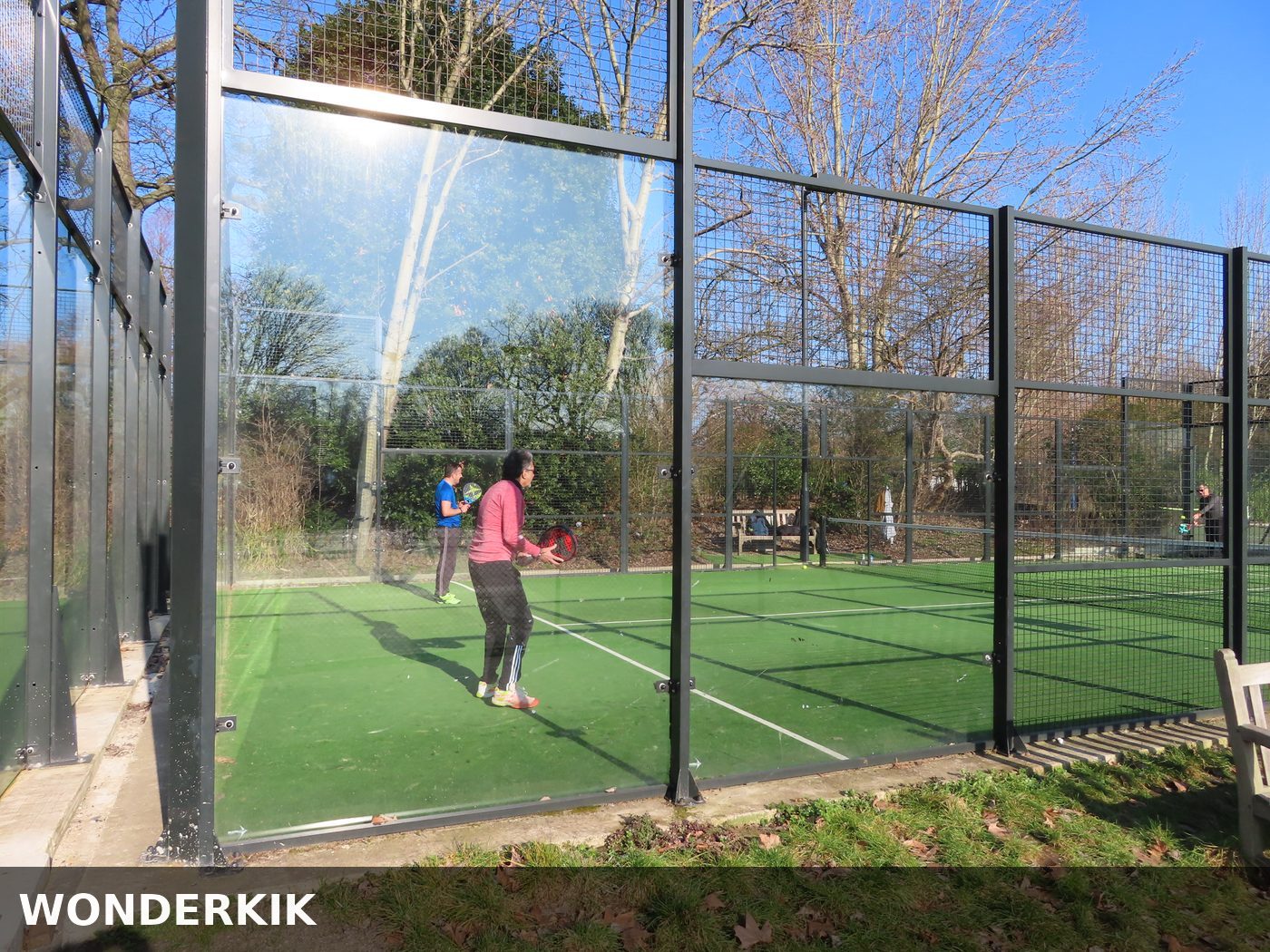
Regent’s Park padel court, showing glass walls – CC CC BY-SA 2.0 (Wikimedia Commons)
The overall size
A regulation padel court is 20 meters (65.6 feet) long by 10 meters (32.8 feet) wide, measured as the interior playable area. The court is a strict rectangle, and every line, wall, and spec below assumes that 20×10 footprint.
Jorge Macri during a padel exhibition at the Buenos Aires obelisk before the sta – CC CC BY 2.5 ar (Wikimedia Commons)
The walls: the defining dimension
The walls are padel’s signature, and they have exact specs:
Back walls: 4 meters (13.1 feet) high at the ends.
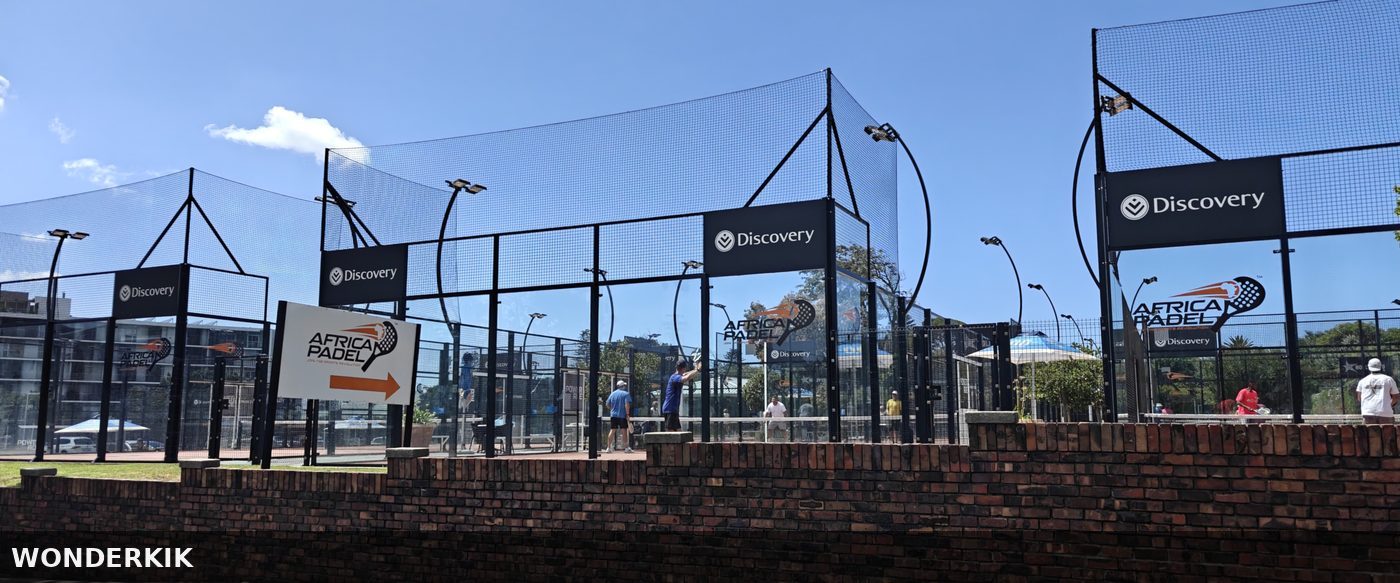
Rear-of-court walls: the back quarter of each side wall and the entire back wall are glazed glass.
Side walls: 3 meters (9.8 feet) high along the sides, transitioning to glass in the back sections and metal mesh above.
Glass thickness: typically 10–12 mm tempered glass; international courts spec 10 mm as a standard.
The openings: door(s) must be at least 20 meters around the court perimeter; on the sides only, never at the back.
The practical upshot: back glass 4m tall, side glass ~3m, mesh above the glass on the sides. The exact glass-to-mesh split matters for play, not just looks — balls rebound harder off glass than mesh.
Net height
Net at the center: 88 cm (34.6 inches).
Net posts: should stand 92 cm (36.2 inches) tall.
Net length: spans the 10-meter court width.
The net splits the court into two equal 10×10-meter halves, like a badminton doubles court turned sideways.
(Compare: a pickleball net is 36 inches at the poles and 34 inches at center — padel nets sit lower, because padel balls are bounced and wall-rebound, not net-clearance-obsessed. Pickleball court sizes live in our pickleball court dimensions guide.)
The service lines
The service line runs 3 meters (9.8 feet) from the net into each half. The service boxes are occupied by that 3-meter-deep zone across the full 10-meter width, with a center service line splitting each half into left/right service boxes for diagonal serving.
Definition, quickly: each 10×10 half has a 3-meter service corridor and a 7-meter back zone behind it. That spacing shapes everything — serves land short-and-diagonal, returns come from a back area you can defend with wall rebounds.
Clearances around the court
International courts require open space outside the court:
Behind the back wall: at least 6.5 meters (21.3 feet) of run-off.
Sides: at least 4.5 meters (14.8 feet) side clearance.
Above the court: enough for lobs over the metal mesh — usually a minimum 8 meters of ceiling or open air.
If you’re converting a warehouse, those run-offs are the dimension people forget and regret.
Surface
Official courts use open-cell, low-density synthetic turf (the dark-green, sandy stuff you always see), often with a fine sand infill. The surface must be non-slip and give consistent bounce. Dirt or hard-court conversions exist for casual play but aren’t FIP-compliant.
What a tournament-ready court needs (quick checklist)
20 × 10 m playable rectangle
Back walls 4 m high, glass panes 10–12 mm
Side walls 3 m high with glass back-third + mesh above
Net 88 cm center / 92 cm posts
Service line 3 m from the net; center service line dividing the boxes
Clearances: 6.5 m back, 4.5 m sides (international standard)
Sand-infilled synthetic turf surface
Court size vs. pickleball, for the curious
Padel: 20 × 10 m (≈1,076 sq ft), walled, doubles-only.
Pickleball: 20 × 44 ft (≈880 sq ft), open, wall-free, doubles or singles.
Padel is the biggest of the “compact” racket sports but its walls do a tennis court’s job of keeping balls in. If you’re picking a sport partly by footprint, that table is the whole story.
The court is 20×10 m, plus international clearances of 6.5 m back and 4.5 m on each side. Realistically a facility needs something like 31×19 meters of usable floor for a single tournament court; many clubs build two courts back-to-back to share clearance.
Are all padel courts the same size?
Regulated competition courts are exactly 20×10 m. Casual or converted indoor courts can vary slightly, but if a court isn’t ~20×10 you’re not practicing for the real game.
How thick is padel court glass?
Typically 10 mm for suspension and 12 mm for sharpening areas — it’s laminated safety glass positioned for the strongest rebounds. Never single-thickness window glass; it shatters under a ball at padel’s rebound energy.
Can I build a padel court at home?
Technically yes and cities across Europe have backyard courts; practically it’s a major project — glass, turf, lighting, house setbacks, and neighbor distance all factor in. Expect a price tag in the tens of thousands and to lose most of your yard. Most people rent club courts instead.
Where do the lines go exactly?
Each half is 10×10 m: the service line 3 m from the net, a center service line running from that service line to the baseline defines the left/right boxes, and you serve diagonally into the far box just like tennis.
Is padel court bigger than badminton doubles?
Yes — badminton doubles court is 13.4 × 6.1 m; the padel court is 20 × 10 m, roughly 2.4× the area, plus the walls on every side.
Racquet sports player and writer covering pickleball, padel, tennis, badminton, and squash. Former collegiate tennis player turned recreational pickleball enthusiast. Jackson writes beginner-friendly guides to help new players get on court faster.













Recent Comments