Pickleball and padel are the two racket sports that show up on every “fastest-growing sport” list these days. They’re often mentioned in the same breath by people who have never played either, and lumped together as “the new racket sports.” The truth is they share almost nothing beyond a small court and solid paddles.
Here’s the honest pickleball vs padel breakdown — what’s actually the same, what isn’t, and which one you should probably try first.
Short list: both use solid-faced (non-strung) paddles, both are played mostly in doubles, both have a cheap-adjacent learning curve compared to tennis, and both are exploding in popularity for basically the same reason — they’re social, accessible versions of racket sports.
That’s where the overlap ends. The court, the ball, the serve, and the soul of the game are completely different.
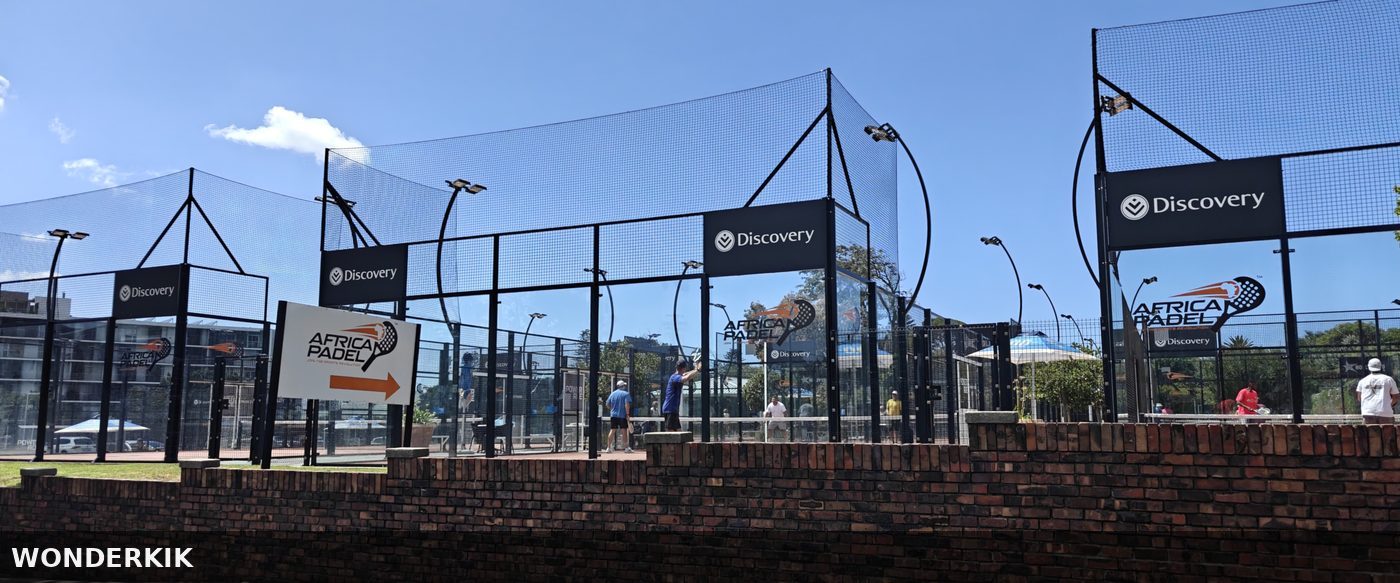
Padel CourtA Pursuit MX 6.0 pickleball paddle by Engage with one blue indoor pickleball and – CC CC BY-SA 4.0 (Wikimedia Commons)
The court: outdoor flat vs. glass box
Pickleball is played on a flat court (20×44 feet) that looks like a scaled-down tennis court. It’s marked with lines — a kitchen, service areas, baselines. Outdoors or indoors, on any surface from concrete to wood. Nothing closes you in.
Padel is played inside a 20×10 meter box — roughly 66×33 feet — surrounded by walls of glass and mesh. The rule you can’t escape: the glass is in play. Rally a ball off your own back wall after one bounce, and the wall becomes your defensive partner. There’s no such thing as “hitting it out to reset” in padel; the wall returns everything.
If pickleball is chess with paddles on flat ground, padel is squash’s cousin inside a greenhouse. Our padel court dimensions guide gets into the exact layout if you want the spec details.
The serve: underhand vs. padel’s kitchen version
Both sports deliberately nerf the serve — no overhead bombs in either one.
Pickleball: underhand, below the waist, diagonal, with the famous double-bounce rule giving the receiver extra time.
Padel:underhand from below the waistline, bounced first, with a serious constraint — the serve must land in the receiver’s service box, and it must then hit the back glass on the fly to be legal in most formats. Like pickleball, the serve starts the point; it never ends it.
Both sports punish serve power; that’s the shared design philosophy. The serve being nearly a formality in both is the biggest thing they have in common after the paddle.
The ball: plastic whiffle vs. pressurized rubber
A different ball changes everything about how these games feel.
Pickleball: a hard plastic ball with holes. Light, floats, slows down fast, and flies sideways in wind outdoors. Control play wins.
Padel: a solid, pressurized rubber ball similar to a tennis ball but firmer and slightly smaller. It grips the wall, spins, and bounces consistently far better on the glass-enclosed court.
Translation: pickleball rewards touch and dinks; padel rewards spin, rebound geometry, and the ability to use the wall as a weapon.
The pace and the point
Pickleball points lean longer for beginners (the double bounce rule buys time), but once you’re good, points get short — one well-placed shot can end a rally. Padel has the opposite arc: rally length increases as players get better, because the wall always rescues a defensive shot. Competitive padel is a marathon of rallies where the score moves slowly and every exchange tests footwork, patience, and read-the-wall thinking.
Cost and availability
Both beat tennis on entry cost, honestly.
Pickleball: the cheapest serious racket sport to start. A paddle $50–110 (our beginner paddle guide gets specific), balls cheap, and — in the US especially — public courts everywhere, often free.
Padel: rackets are mid-range comparable to pickleball paddles (more in our padel racket guide), but the courts are expensive to build (glass walls), so public padel access depends heavily on where you live. In Spain, Argentina, and across Europe, padel clubs are everywhere; in many US regions you’ll hunt for a facility near you.
Availability is the biggest practical difference for most people. Check court access in your area before falling in love with the game you can’t get to easily.
Fitness and who you’re playing
Both are doubles-heavy social sports that play fine into later age. Pickleball is gentler on the body out of the box (no wall collisions, no diving). Padel, once you’re past beginner level, demands real athleticism — lunging off glass, covering an enclosed court, and building up the lateral movement that wall play requires. Serious padel is a proper workout; casual pickleball can be a light one.
Which should you play?
Try pickleball first if you:
– live in the US or somewhere with public pickleball courts nearby
– want to be playing this week at near-zero cost
– want the gentlest possible entry to racket sports
– prefer outdoor, bright, simple spaces
Try padel first if you:
– live where padel clubs are established (Europe, South America)
– like the idea of a tactical game with walls — squash fans, listen up
– want a racket sport that’s still social but rewards spin and geometry over touch alone
– don’t mind booking indoor court time
The honest take
Pickleball is the better first stop for most beginners purely on logistics: it’s cheaper, more available, and its learning curve to “having fun” is the gentlest in the sports world. But padel is not a compromise pick — for a lot of players it’s the better game, deeper and faster, and the wall play creates moments you just don’t get anywhere else.
If you can, do what a growing number of players do: start with pickleball for the weekly social hit, and book one padel session to find out whether the wall sport becomes your main thing. Two racket sports is one more than the average adult will ever try, and both of these reward showing up.
No. They look similar but the faces, weights, and hole patterns are tuned for different balls and game dynamics. You need a padel racket for padel and a pickleball paddle for pickleball.
Which is more popular?
Pickleball is far bigger in the US (millions of players, constant court construction). Padel is ahead in Spain and much of Europe, with explosive year-over-year growth and an Olympic bid in view (Brisbane 2032). Popularity is very regional.
Which is easier for complete beginners?
Pickleball. The court is flat with no walls, the double-bounce rule gives you time, and public courts make it easy to practice casually. Padel has an extra mechanic (the wall) that takes a few sessions to understand.
Which is more fun at the competitive level?
Subjective, but padel players tend to love the tactical depth of wall play, while pickleball’s tournament scene is bigger and more established right now. If you like chess-with-a-ball and rebounds, padel’s ceiling is enormous.
Where do I find padel courts near me?
Search “padel courts [your city]” — availability is club-based. Indoor and outdoor options exist; rates and singles access differ by facility. Compare with a couple of pickleball park courts before deciding where to invest weekend time.
Racquet sports player and writer covering pickleball, padel, tennis, badminton, and squash. Former collegiate tennis player turned recreational pickleball enthusiast. Jackson writes beginner-friendly guides to help new players get on court faster.














Recent Comments